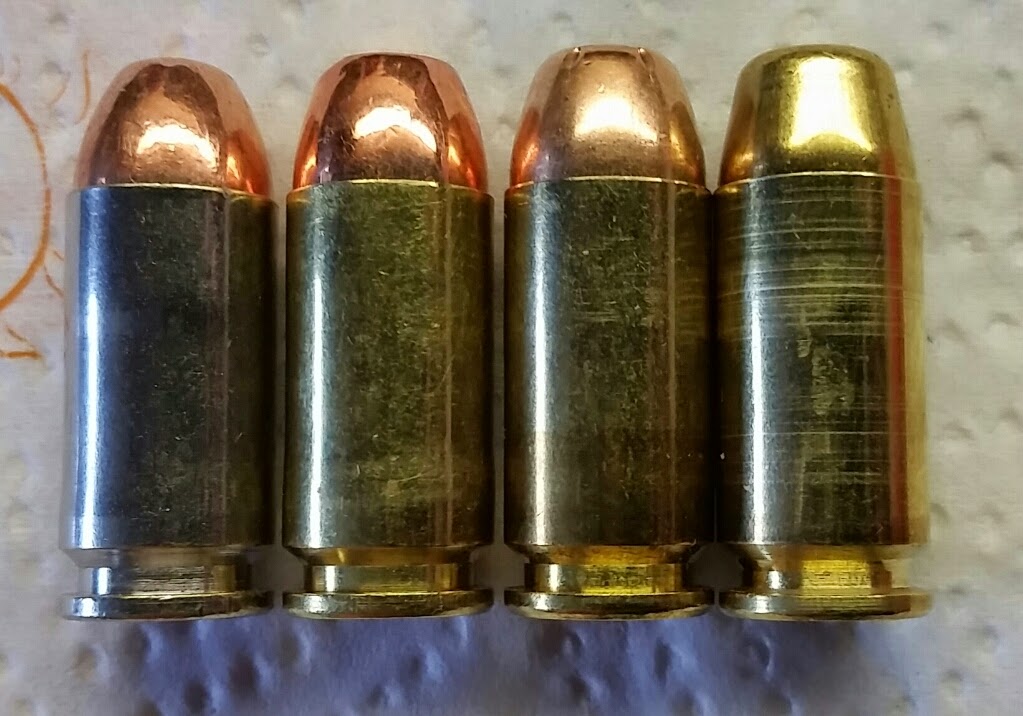
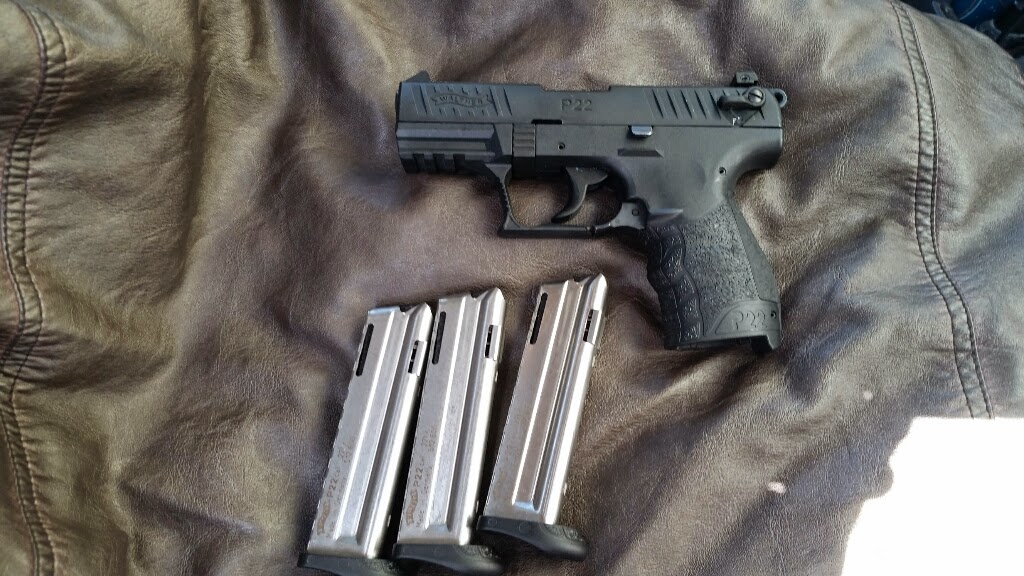
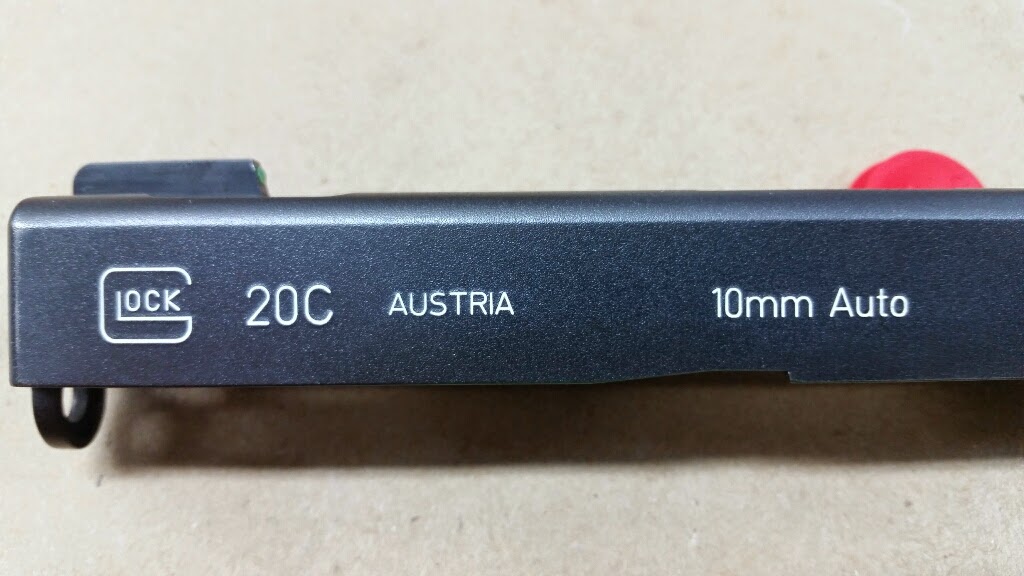
All posts by admin
Punching Holes Gently, Continued…
The 13 pound spring did seem to help operation of the pistol in general. With the stock spring, I had several issues where extraction and ejection seemed to not complete in pretty much every stage I shot. The lighter spring as reduced that greatly, but it has not completely eliminated it. Last Thursday, I still had a couple of them.
Also, the lighter spring seems to have made the pistol a little less forgiving about about case mouth tolerances and thus I had a few failures to go into battery.
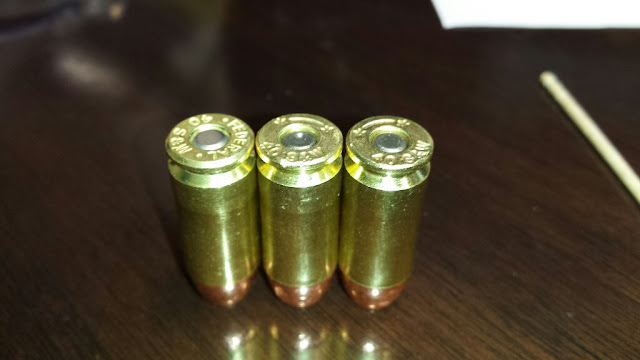
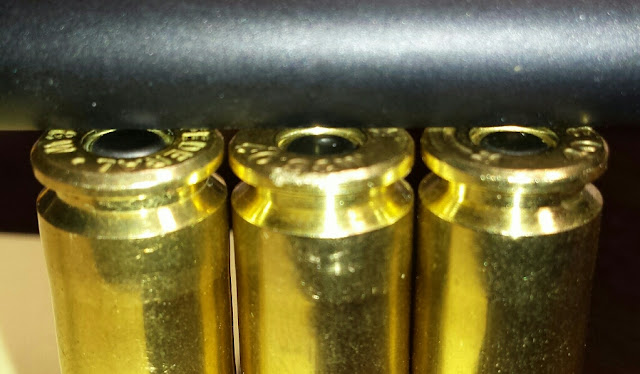
In my defense, though perhaps it’s not a truly warranted defense, I have found that I can have rounds that drop freely into the gauge block but close observation reveals a tiny bit of the flared mouth remains. This might not be an issue on a Glock 22, with it’s native 40S&W magazines, but using the 10mm mags and a 40S&W conversion barrel might introduce enough geometric change to take up all the usual tolerances and result in a failure to go into battery.
Message received, Cody. I need to mic those case mouths. Adjusting the crimp die will be very simple and will probably take care of it.
So, with the BUG match coming up this weekend, I have two critical ammo related problems to address.
Even the lighter spring on the Glock isn’t quite light enough for the current load, so I need to bump up the powder charge just a little. As I am using the Lee Pro Auto Disk powder measure, I will just go up one cavity size on the disk. I think I’m using the 0.40 cc cavity and the next larger 0.43 cc cavity should raise the powder charge to about 4.8g. This should add about 50 fps to the velocity, but more importantly, about 31 foot pounds of energy to the slide.
Of course, that whole paragraph applies to shooting the Glock. For the BUG match, I’ll be shooting the Kahr, and I haven’t tried that ammo at all in that pistol. The current load might work, or I might need to bump that even higher for the Kahr. I may be able to test that this evening.
Spring Is In The Air
No, spring is in the Glock…
The 13 pound recoil spring worked as expected. I did have two ammo issues, but they appeared to be ammo dimensional issues.
As I was rushing somewhat to have 100 rounds of this low recoil ammo recipe ready for the match, I QA’d the rounds with the gauge block only. Usually, I run all rounds through the Bulge Buster first, then case gauge block. In the interest of cranking out 100 rounds that morning, I just cleared all rounds though the case gauge only. If they drop unrestricted into the block, I called them good. I’m not sure if that allowed a couple of marginal rounds through or not. Shrug.
What I really need to do is take a few hundred rounds to the range and test them under non-competitive conditions, with the chronograph, too.
I have also been looking into a bullet trap for easier and safer ammo testing at home.
We have about 12 acres of land in a subdivision with a minimum lot size of 5 acres. We have a pond on the property which includes a dam that I have used as a firearm backstop before. However, that area is muddy much of the spring rainy season, limiting access to keep it mowed. Consequently, it is overgrown much of the rest of the year. It is a good place for daytime target practice, for part of the year, but it less than convenient for the kind of shooting needed to work up a handload recipe.
After shopping for commercially available bullet traps, I have found that there are a few available that would suit my needs fairly well, but they tend to be $1000-2000 and I just can’t justify that kind of cost. I think I’m going to have to go homebrew.
There are three *basic* designs for small bullet traps, four if you include clearing traps. Clearing traps are designed to simply be a safe direction to point the muzzle when unloading and clearing a weapon. They are not truly intended to be fired into regularly. For bench work, a sand filled bucket is adequate for most handguns.
The other bullet trap designs are variations on a theme of safely dissipating a bullet’s energy. The most common design, both commercial and home made, uses a hard steel plate, generally at somewhat of an angle to the shooter, to absorb most of the bullet’s energy and deflect it into a soft material, often sand, to absorb the rest of the energy and capture the projectile. The home made version might be adaptable to indoor shooting and in fact, many indoor and even outdoor ranges use another variation of this technology wherein the angled steel plate deflects upward, but the plate is covered in several inches of shredded tire rubber.
Another very common design that is a little more complex is some form of a design that uses highly angled plates to deflect and guide the projectile into an enclosed tube to dissipate the remaining energy in the tube. This design makes recovery of the spent projectiles easier, thus making the lead easier to recycle. The specifics vary somewhat, but they mostly look like a big funnel connected tangentially to the side of a pipe. This would be my favorite design to try, mostly because there is no need for any kind of sand, ground rubber or other media to sift spent projectiles out of.
The last common design is really basically a scaled up clearing trap, a tube filled with baffles or some other energy absorbing media, large enough to safely shoot at from a distance. One of the slickest example of these was from a company called Target Shooting Solutions. As of November 2017, their web presence is now for an indoor range in Pennsylvania, with no bullet traps to be found. Sadly, their least expensive model was $1000. However, their basic design lends itself somewhat to the DIY builder, a tube filled with absorption media.
The easiest to build your own tube trap with would be 12″ or larger steel pipe, about 3 feet long, with a heavy plate securely welded to one end, the other end made of something a bullet should be able to pass through, like a piece of a horse stall mat.
Punching Holes Gently
I loaded up some soft shooting 40S&W ammo to take to Winchester last Thursday. In the past, I have loaded a lot of 165 gr RNFP rounds and got very comfortable with them. 4.5 gr of TiteGroup send those at about 960 fps (per chrono stage at a major match) for power factor of 158. That round worked really well. Hotter than necessary, perhaps, but as I say, I had gotten pretty comfortable with them. I never did chrono the 155 gr RNFP with the same charge, but those are probably a little faster, still in the 160 or so range in power factor.
I decided that since I espouse custom ammunition as one of the two main reasons to handload (economy being the other) that I could probably do better.
The rule of thumb is that, for a given power factor, heavier bullets at lower velocities will recoil with less energy. The math works because power factor is a simple momentum calculation of mass time velocity whereas energy involves the square of the velocity. So, the next heavier common 10mm bullet is 180 gr. To make minimum power factor of 125, the 180 gr needs only run at a pretty pokey 695 fps, as opposed to 758 fps for a 165 gr bullet. I consulted various load data sources and found a few loads with fast powders that showed 180 gr bullets at 750-ish fps and I decided to try 4.4 grains of Power Pistol. The slightly longer 180 gr bullet was seated a little bit deeper in the case, but as the profile/ogive is the same as the 165 gr, I used the same OAL of 1.125″ and all rounds gauged properly in my EGW case gauge.
There is, however, a caveat.
Using the math referred to above, my 165 gr bullets at 962 fps works out to 339 foot-pounds of muzzle energy and by inescapable physical law, 339 foot-pounds of recoil, though a goodly portion of that is used to operate the pistol. My 180 gr bullets at an estimated 750 fps works out to 225 foot-pounds, 34% less energy. That, it turns out, is enough reduction to make the pistol cycle less reliably.
The round was an absolute joy to shoot. Reacquiring the front sight was fast. Power Pistol is a bit flashy and boomy (and I have in fact some pretty smokin’ hot, bright and loud loads using Power Pistol) but in this charge, it was a nice report and very light recoil. It won’t be confused with a 22, but very gentle. On the other hand, I had several jams that centered around incomplete extraction and ejection. I was initially disappointed, fearing I had a dimensional issue, but as I paid closer attention to the jams and noticed that it was empty brass gumming up the works, I realized that my pistol just has too much recoil spring for these far-lighter-than-factory loads.
This is a Glock 20 with a Lone Wolf 40S&W conversion barrel but the stock recoil spring designed for 10mm Auto. It kind of surprised me to learn that the stock recoil spring for the Glock 20 is the same 17 pound rating as the stock spring on almost all other models. Then I realized that what is different for the Glock 20 (and 21) is the larger, heavier slide. The combination of the heavier slide and the 17 pound spring is what helps the pistol cope with the 575 to 800 foot pounds of recoil energy of full power 10mm ammo. Compared to that, its no surprise that my 225 foot pounds, a paltry 60% less energy, might have trouble operating the pistol reliably.
I ordered a 13 pound spring on Friday. Tracking said it woudl be here by Friday, but it arrived today! Bonus!
Thursday Night Back to Normal(ish)
Thursday’s Match Director brought us a few stages lifted from the IDPA World Match and, just to make it easier for all, he set up all four stages in one space. We didn’t have to stop and reset after two squads did two stages, as is the norm.
Scoring was less than stellar. The biggest problem seems to be that I failed to slow down.
I did have one interesting PE. The stage had two targets visible from P1, two “surprise” targets obscured by visual barriers enroute to P2 and one behind the barrier at P2. Two on each except the last, which gets six. My plan was pretty simple and similar to almost everyone elses, 2 each, advance, 2 on the first surprise, shoot to slidelock on second surprise, reload behind the barrier, 6 on the last.
Where I went wrong must have been in the count. I shot at the 2nd surprise target and initiated my reload, only to notice that my magazine was empty, but that there was a round in the pistol; it wasn’t at slide lock. I am pretty sure I retained my magazine, reloaded and took the last six shots. I got a PE for it and I was not at all surprised, so I had no reason to review the details.
During the day today, I was discussing the match with coworkers and when I described what happened, it occurred to me that if I retained the magazine, it would be a tactical reload and maybe should not have been a PE. I consulted to rules and verified that a magazine can be empty at tactical reload. What makes it a TR is that there is still a round in the pistol and you do have to retain the magazine, not drop it. I emailed the SO that I thought had run me on that stage and we ended up chatting on the phone about it. Turns out he wasn’t who ran me, but he observed that the PE was for initiating the reload before I was behind cover, not the reload itself. I feel better now. 🙂
Overall, I placed 12 out of 16 shooters, but really I was 4 out 5 Markman ESPs.
I definitely need to shoot a lot more and get back in the groove!
Speaking of scoring, news from the banquet at the IDPA World Match is that they are going to change the penalty for points down. Currently, each point down is a half second. The change is expected to be to a full second. There has been much forum discussion about it. The intent seems to be to discourage shooting real fast for a bunch of 1’s and thus encourage accuracy. I’m not convinced that is the best way to do that, but it will make the math of scoring easier 🙂
Rejoining Society
Oh, it was fun shooting again last Thursday!
And there was a cool stage shooting under a “garage door” laying on one side!
Thanks go out to Josh C for letting me nab his PoV video, from which this still came.
Score-wise, considering I was rusty from 155 days between matches, I did ok, middle of the pack stuff. No huge problems.
I did have a little trouble with ammo failing to go into battery. I was shooting 40S&W, 155 gr RNFP over 4.5 gr Titegroup. Historically, I know that these boxes were loaded during the time I was dialing in on some consistency issues, so a couple such issues were not totally a surprise. After I got home, I ran a bunch of these rounds through an additional Bulge Buster and gauge block QA process. There were about 10 rounds out of 250 that I could not refurbish.
Friday was a quarterly classifier. I was somewhat interested in trying for Sharp Shooter in ESP, but decided instead to go for BUG. I had a ‘default’ Novice classification in BUG (9.6.2.1 A shooter’s initial BUG classification is the shooter’s highest Classification attained in any division, minus one level) but Marksman is the minimum classification required for a sanctioned match. I like those, so I thought that would be best.
Having had some ammo issues on Thursday, I elected to buy factory ammo for the classifier. From the limited choices I got the heaviest bullet, hoping it would be subsonic and maybe lighter recoil. I’m not sure if I chose correctly, because by the time I was done with 90 rounds, I had a blister on the bottom of my trigger finger due to recoil from the little Kahr CW40.
I made Marksman in BUG. The range for Marksman BUG is 171 to 234 seconds and I shot a 206. My biggest problems were the longer range shots. The classifier is Limited Scoring, so no makeups are allowed anyway, but I couldn’t see well enough to determine whether I made those shots until we scored the targets.
Still, 206 is well above 234, so I’m in.
Last night, I had planned to go practice for a while. In the afternoon, however, I had a fairly extensive eye exam, which included dilation. By 6PM, my eyes were still partly dilated and I had troubles focusing at much distance. It wasn’t too bad driving, but I think the precision of shooting would have required more acuity.
I may as well mention now that the eye exam was to see if I have glaucoma. There isn’t really *a* test for that, but rather a battery of tests that, taken as a whole, determines the answer. While not all tests are completed, my opthamologist says that I am “glaucoma suspect” until they finish looking at everything. With all the various chemicals they assaulted my eyes with for this exam, there were some tests that could not be done on the same day, so I have another appointment in about a month for the rest of the battery of tests. Being nearsighted indicates a risk for glaucoma and at the same time, can give a false positive on some tests, looking like glaucoma when it’s not. Also, I apparently have pretty thick corneas, which serves to protect the iris from one common cause. In the mean time, I take comfort in knowing that if I do have glaucoma, we have detected it very early and it will most likely be completely manageable, though that will be a “rest of my life” type of management, particularly since glaucoma usually doesn’t present any noticeable symptoms until you have already begun loosing eyesight. Treatment is most commonly drops that are like localized blood pressure drugs. In some situations, laser or conventional surgery is indicated.
Here’s my scoresheet 🙂
Time Waits For No One
It’s hard for me to believe that my last post was nearly 5 months ago!
Then again, it’s been a tough 5 months. We had flooding level rains on at least two occasions in the spring, work had me travelling to California a few times and this last month has been the worst, emptying out our old house so we can sell it. Man, I wish we had done that when it was cooler.
Sale closes tomorrow, now all we have to do is dispatch all that stuff we moved. We sorted a lot of it for trash/charity/keep status before we moved it or we would really be crammed in. We have a 45 foot shipping container that is approaching full, the barn and workshop are packed, the little metal shed that is intended for lawn mowers and such is full and my wife’s car has been parked outside of the garage for weeks.
One interesting thing that I rediscovered is a set of RCBS 10mm/40 dies that I *knew* I had, just not sure where they were! 🙂
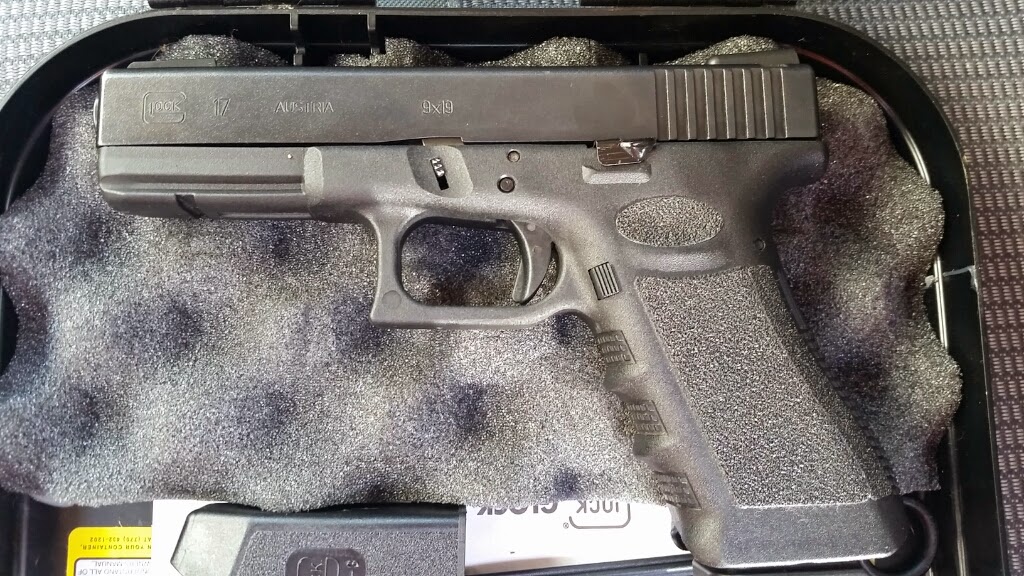
So, it’s looking possible that I might be able to actually attend my first IDPA match since late April. Since I’ll be kinda raw anyway, I’m thinking of going ahead and shooting the G17. The previous owner put some nice sights on it, so I’ll be right at home with them…
Speaking of 9mm, Xtreme Bullets is now carrying cleaned and primed brass for about the price of brass plus primers. Since I have a 9mm pistol now, I went ahead and ordered 1000 rounds of 9mm primed brass and four weights of 9mm plated bullets for experimenting with. I’m guessing that the heavier bullets are going to be the nicest to shoot; generally speaking, a heavy bullet loaded to a low velocity will be easier on the body and still make minimum power factor.
I also got a little more than 1000 rounds of new Starline brass in 40 S&W. I have never loaded with new brass. At least, I don’t remember every loading with new brass. It’s not like I was low on 40 S&W brass, but…
Succumbed to Temptation
Sight Swap
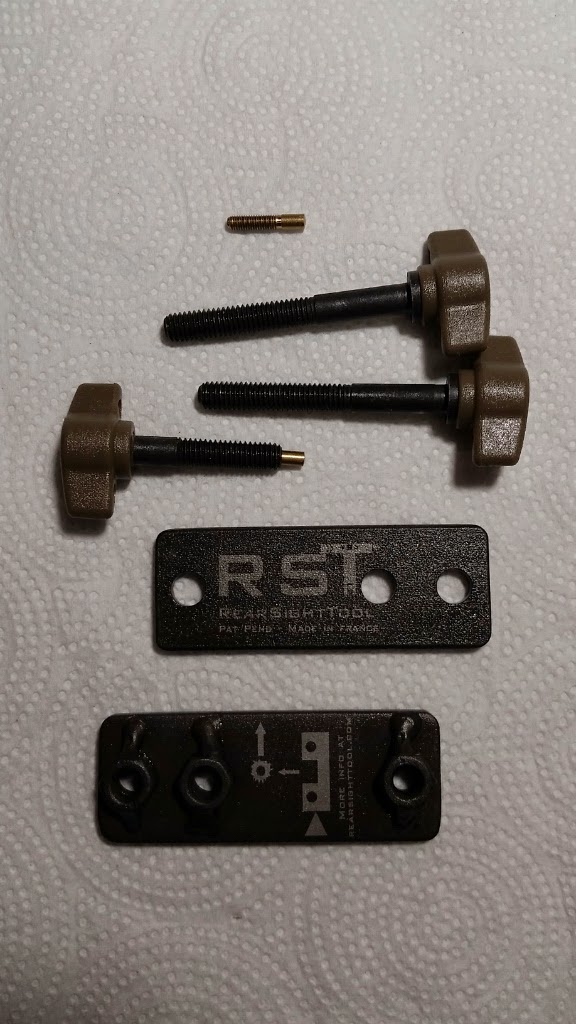
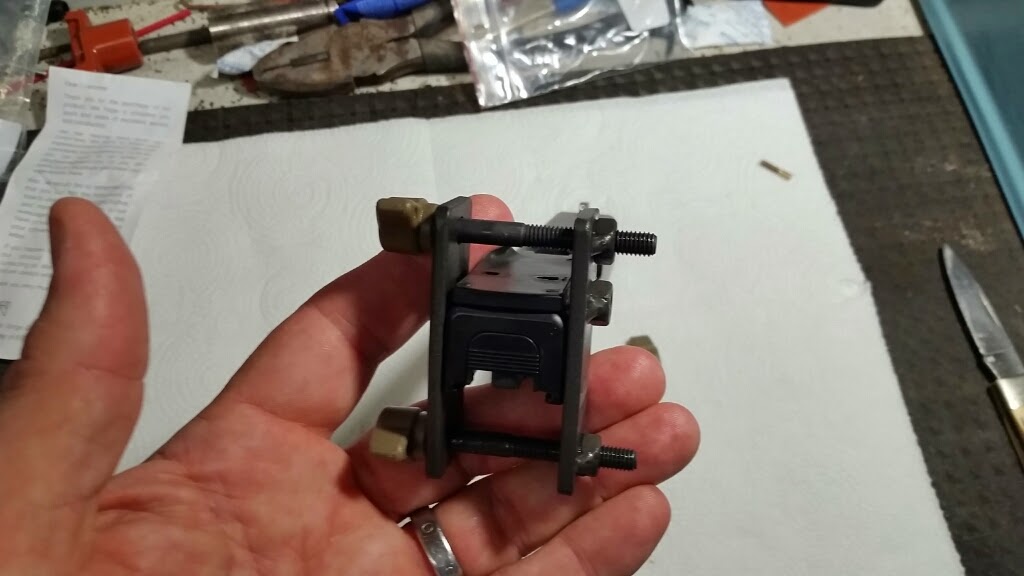
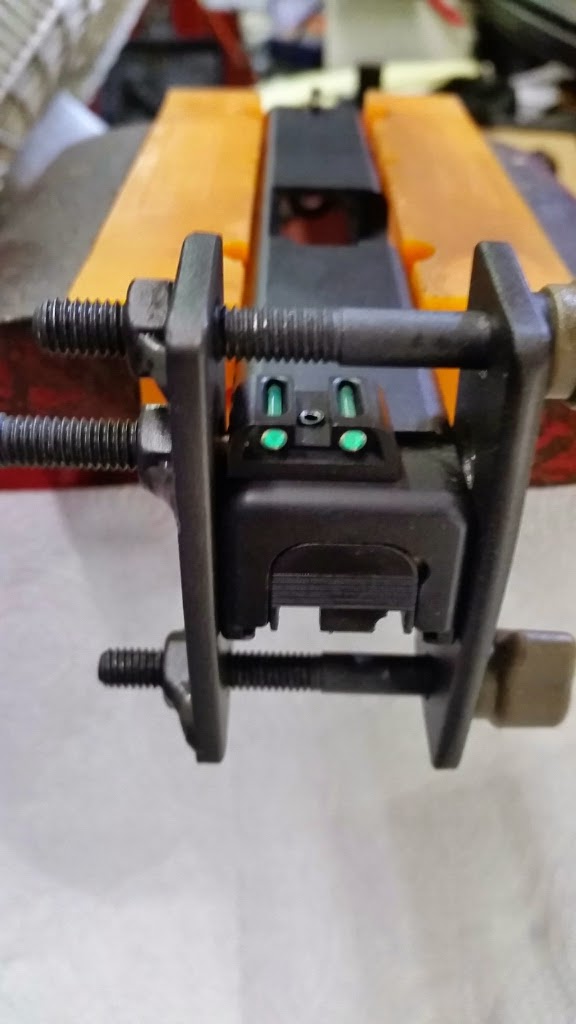
I finally swapped out the Burris red dot sight on my G20 non-compensated slide for a set of TruGlo fiber optic sights. I got a compact sight pusher tool from RST. It’s a simple & clever “I could have made that” design but I didn’t have to.
The pusher consists of two steel plates, both with holes and one with nuts welded in front of them. There are two long thumbscrews for clamping the slide between the plates and a shorter one with an interchangeable tip that does the actually pushing work.
Clamping the pusher to the slide is pretty trivial, beyond aligning the pusher screw to hit the sight but not the slide.
The base plate of the Burris sight is only slightly narrower than the slide, so all this pusher could do was pop it loose and start it moving. I put the slide in a vise and tapped the sight the rest of the way out with a handy deadblow hammer, which was bigger than needed. I have no doubt that I could have completed the removal without the vise if required.
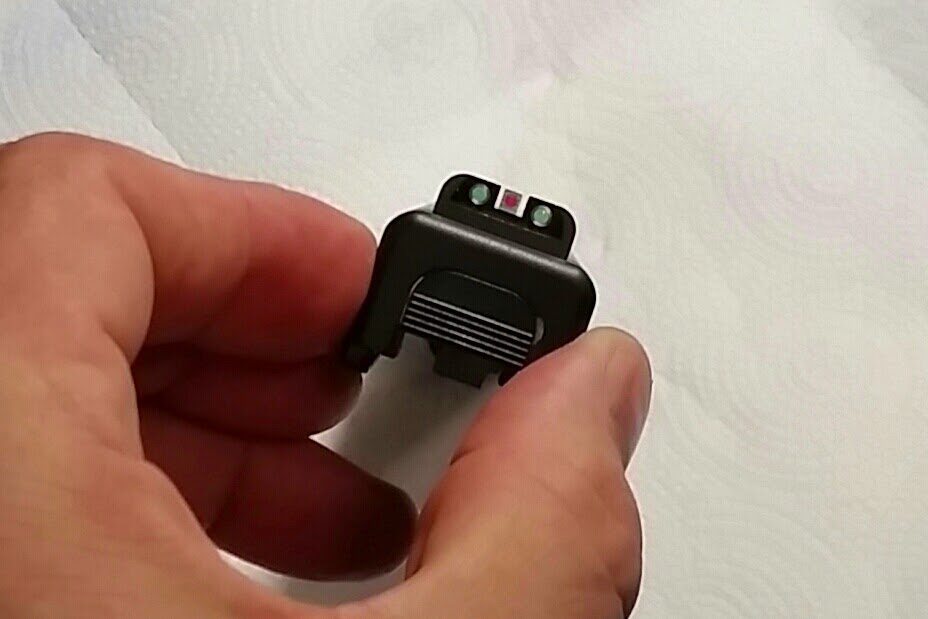
Installing the new sight was pretty much exactly the reverse of removing the old. I had to tap the new sight far enough into the dovetail for the RST pusher plate to be able to clamp to the slide, then the pusher very easily and precisely moved it into place.
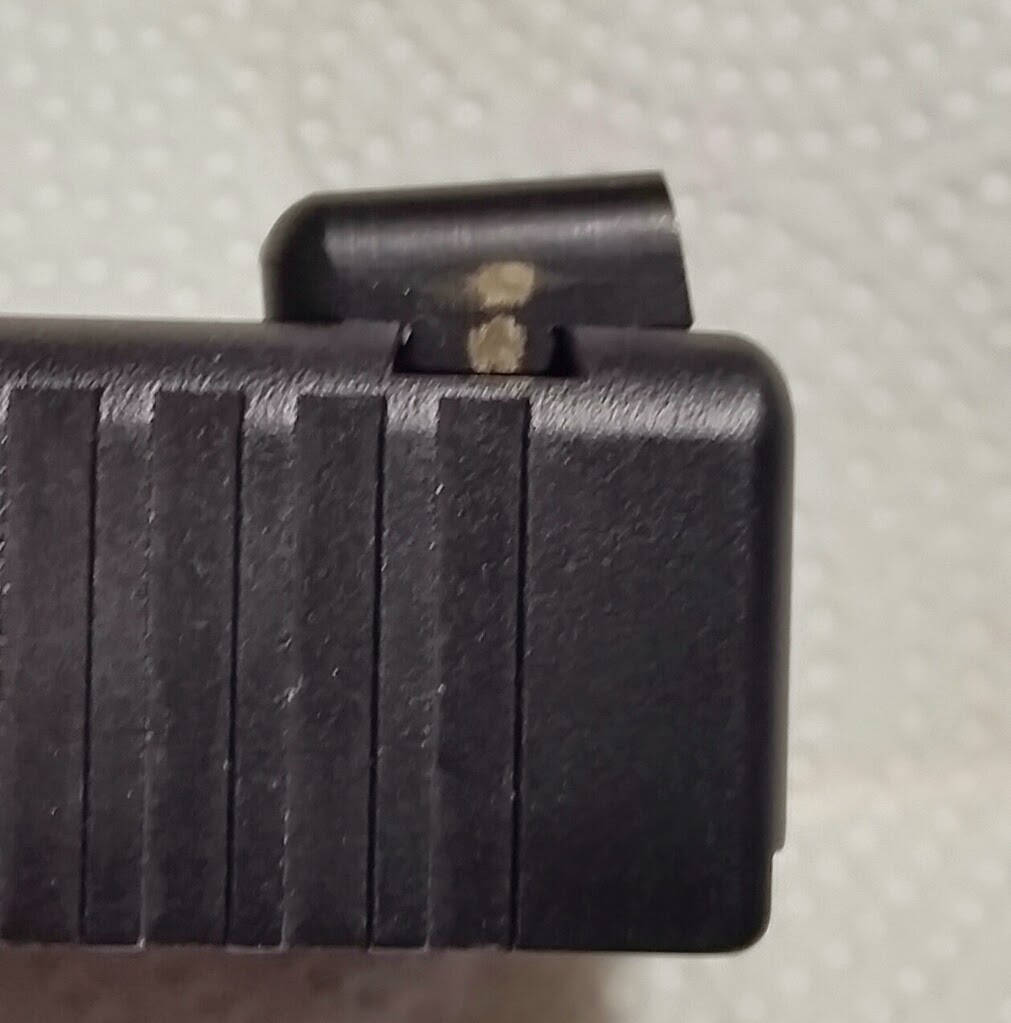
That pic was deceptively hard to get. The focus depth of field on my smartphone is narrow enough that I had to hold it almost at the limit of my reach for front and rear sight to both be in focus. Since I needed to crop most of the pic, I had to turn the resolution up to max. Pretty happy with it, actually.
The one complaint about the RST was something I might have been able to avoid, but the soft brass pusher tip left brassy colored scuff dots on the black finish on both sights. This is mostly removable, but particularly on the Burris plate, cleaning the brass dot off left a slightly polished finish. I think that is because the Burris plate has a paint/powdercoat finish and the TruGlo is some sort of chemical finish like anodizing.
The tool comes with a spare brass point and a steel point. The steel point may have actually been better for not leaving these marks. If I need to adjust the TruGlo sight, I will test the steel point for that.
Some Overdue Customizing
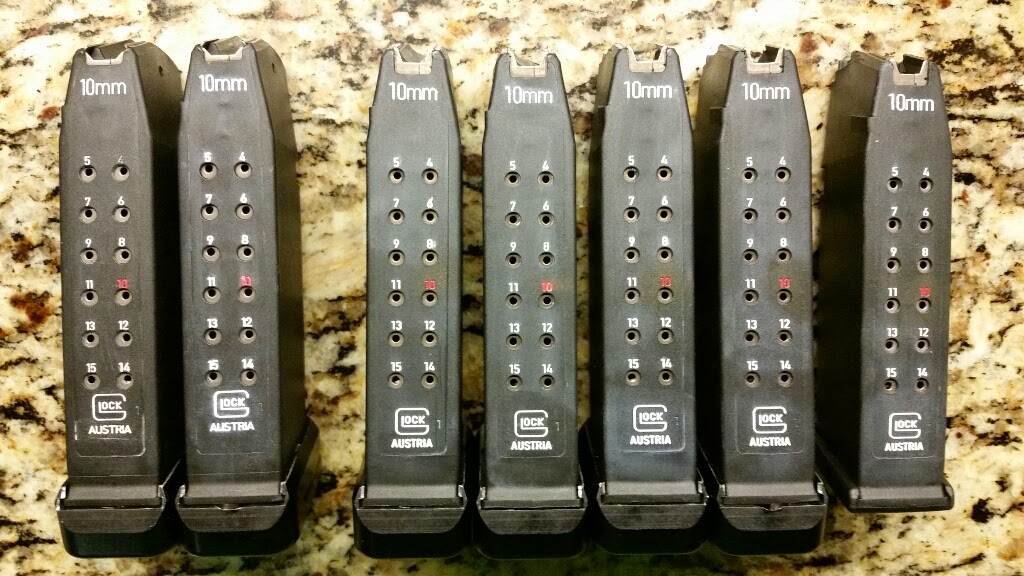
Though it is a fairly common “mod”, I had not taken the time to paint fill the imprinted lettering on my magazines and the slide of the pistol.
Pretty happy with the added contrast. It doesn’t help it shoot any better, but it was a nice project that I could do in a couple of hours with a bonus of spending time with my Love in the craftroom.
As an aside, I noticed while doing this work that the screw holding the front sight is loose. It will be an easy enough fix, removing the screw and sight, cleaning with acetone and reassembling with Locktite.
There are many descriptions on the web as to the lettering procedure. In my case, I first cleaned the slide and magazines with acetone. Next, I used plain ol’ Testors model white enamel and a size 0 detail round brush. Technically, I was globbing it on to fill all the lines, but I tried to keep the glob in the lines and the part outside the lines as thin as reasonably possible. I filled all the lettering except for #10, which I went back and did in red. I wish I’d had a brighter red, maybe a fluorescent red or orange, even green. The point is that #10 is also filled but in another color. In IDPA shooting, magazines in my divisions are typically loaded to 10 rounds and since I am corrected to slightly farsighted with my contact lenses, it is hard to make out even the higher contrast lettering to read the actual number. Making the 10 another color makes it easier to check the magazine capacity.
Once all the paint was well dried came the somewhat tedious bit. I used the Testors thinner on bits of paper towel. It took a couple of magazines to refine the technique, but what seemed to work well was to put a drop of thinner on a small piece of paper towel and quickly rub it over a small area of lettering, checking between each stroke. When only the desired coloring is left, buff the area with a dry paper towel. This was the fastest way and required the least retouching cleanup. The thinner needs to be really light on the towel. Too much on the towel and it wets the paint too much and too much is removed from the lettering. I did all the white then came back to the red with fresh towels to keep the white from becoming kind of pink.
I pretty pleased with how they turned out.
In a previous post, I noted that I had a magazine that did not easily drop clear at reload time. Since I had numbered the magazines, I knew which one it was. While I was preparing the magazines, I had them all in one place and wanted to compare this troublemaker with it’s stablemates. I found a couple of differences that I am sure are documented online somewhere else, but here goes….
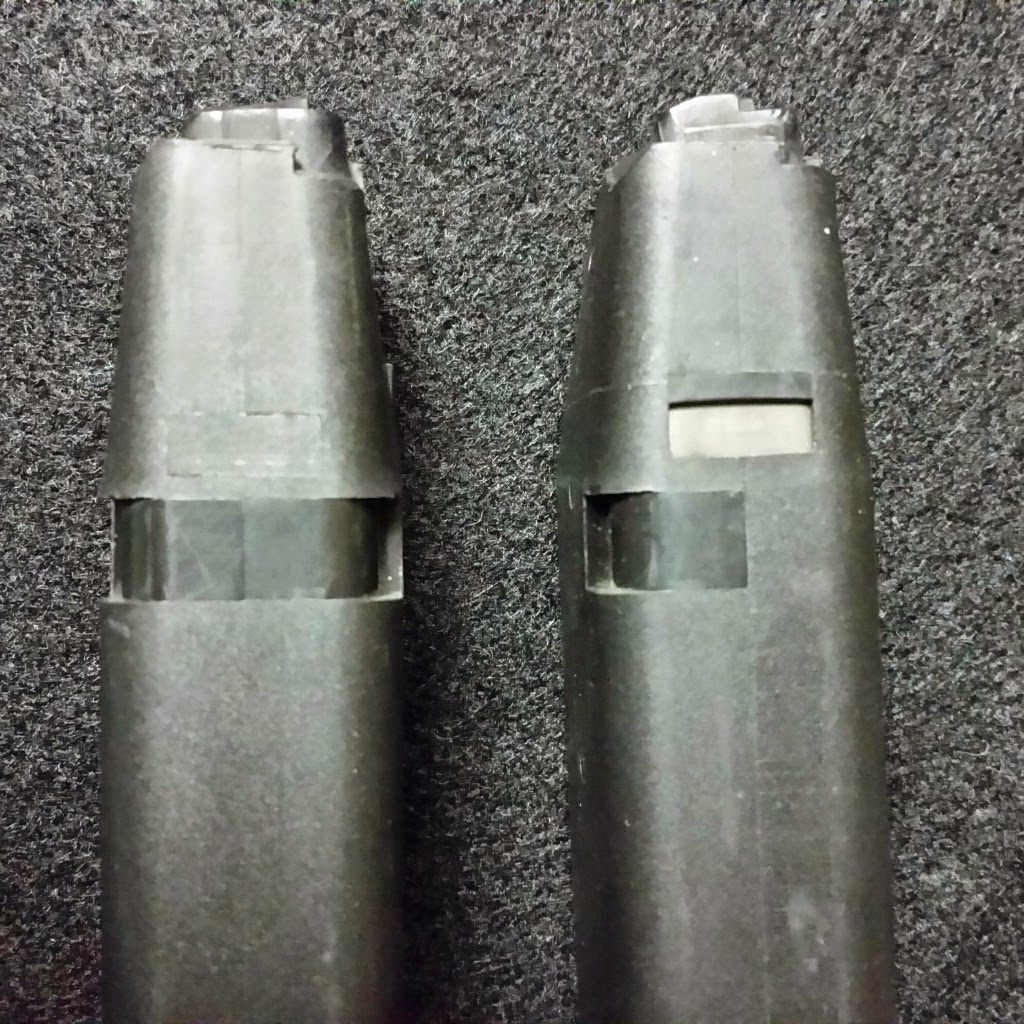
Since the empty magazine wasn’t dropping well when released, I first wanted to compare the latching notch. It turns out that there was a pretty big difference immediately visible. The magazine on the right is the one that doesn’t drop well.
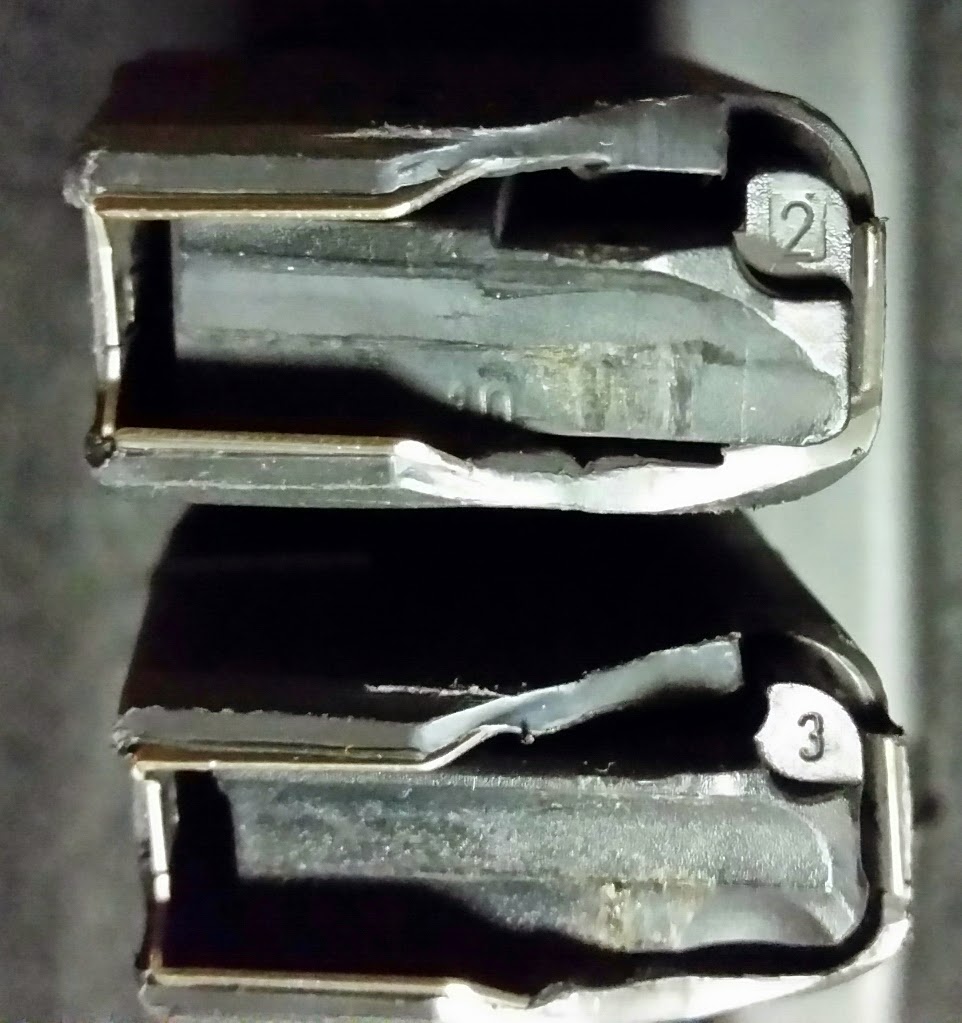
In further digging, I noticed a difference in the followers as well. The one marked with a 2 is the one that doesn’t drop well. Due to the shadow, it’s hare to see, but the top magazine follower has a simple ’10’ on it while the bottom one has ’10 mm’ completely obscured by the shadow.
Referring back to the pic above of all the magazines, note that the two on the left are slightly different in the placement of the Glock logo. Yes, I have two magazines of this different model. In the original numbering order, these were magazines 0 and 2. The first was easy to remove from the magazine order. I did all other shooting with magazines 1, 2 and 3. However, I have so rarely had to drop mag #2 on the clock that I haven’t noticed if it also had trouble dropping clear.
Partly to address this issue and partly because I just have them, I decided to install the six magazine extension floor plates that I got in the box of goodies that included, among other things, most of these magazines. The previous owner found that, with all other equipment on his pistol, these extension floor plates in stock condition made the overall weight of the pistol perilously close to overweight for IDPA. He drilled out some material from the inside of the plates to reduce the weight. I hope my combination of parts fits under the wire because the added weight to the magazine makes all six thus equipped drop out of the pistol nicely. I have put them on both of the ‘odd’ magazines for the acid test.
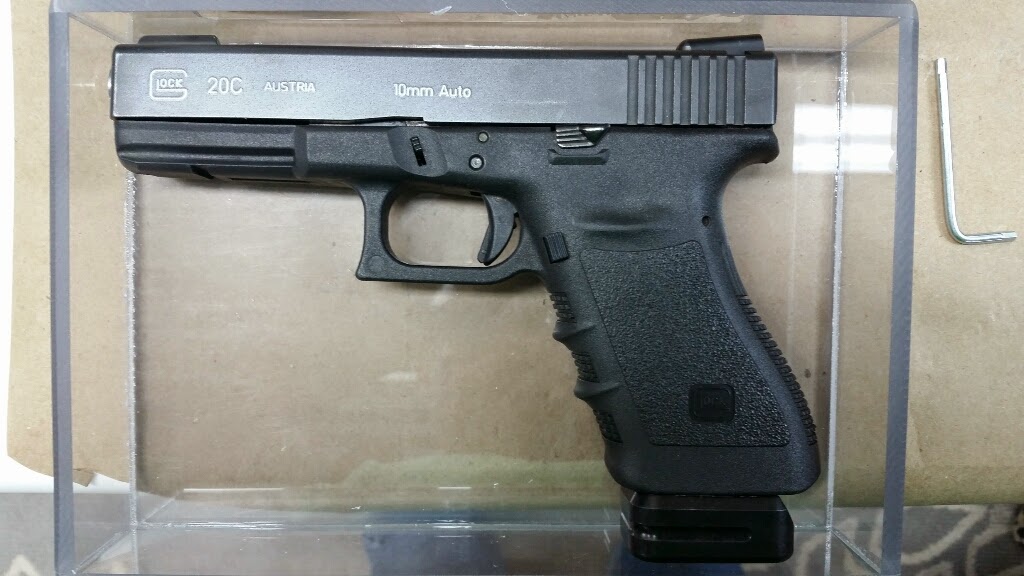
The pistol is a close but passing fit in the IDPA box with the extensions.