for you and me….
I always thought it might be cool to have a Geiger counter. On the other hand, I never wanted to NEED to have a Geiger counter, ya know? Happily, it’s still optional, but the options are pretty compelling.
I was born in the early 60’s and like almost everyone else on the planet, I was quite taken with Apollo. I recall my older brother putting one of his friends’ motorcycle helmet on me and setting up a closet with a chair and few reimagined toys so that I could be an astronaut in my capsule.
While his interests ran more towards organic chemistry, I picked up more of a technological gene and I tended to build stuff. And take stuff apart. My father was a jack of many trades and I learned a lot about building from him. He was also a lapidary, which broadened my view into material sciences. By the time I was in middle school, I had long outgrown what the Radio Shack 150 in 1 electronics experimenter kit could offer. It was an absolute favorite Christmas gift.
Fast forward a bit and my career has been almost 100% technical and almost all of that has been one form or another of communications.
Having experienced the entirety of the Cold War as an observer, I was fascinated by nuclear energy. It is actually extremely low tech. Just bring a certain amount of certain metals close enough together for their base characteristics to magically generate essentially STUPID amounts of power. On the other hand, understanding and controlling this low tech challenged some of the most brilliant and gifted minds that the world has seen, before or since. It sometimes found them wanting.
I didn’t know that I liked math at that time. I think I just didn’t like the math we were being taught. I think it seemed like a lot of busy work, with no real tangible benefit. I’d rather keep designing circuits LOL. It’s amazing that a lot of what I played with worked at all, considering that I was just easter egging components and seeing what happened. I understood at some level that engineering was pretty math-y, but not in a way that triggered any interest in math. I had D’s in math class, but I calculated how many holes were in the acoustic ceiling tiles in the library at school, using what I didn’t realize at the time were statistical methods.
And it turns out, a LOT of the math in nuclear science is statistics. Whoda thunk it?
My practical interest in radiation stayed well below ionization energies. I worked in broadcast television, two-way radio, became a ham radio operator tinkering with microwaves, and implemented wireless burglar alarm systems long LONG before anything nearly as advanced as LTE or WiFi. When my career moved more into telephones, that eventually because digitized and eventually Voice over IP came along, giving me a significant shift in data rates, but no technology that I hadn’t already be working on or at least adjacent to since age 19. I’m 60-something now.
Beyond the brief but real concerns for global thermonuclear war in the middle there, ionizing radiation thankfully played very little *directly* into my life. In the burglar and fire alarm career, ionization smoke detectors are a thing. They work by measuring the resistance of a column of air that is ionized by the constant alpha emissions from a TINY piece of Americium 241. When some products of combustion enter this column, they raise the resistance of this column of air, triggering the alarm.
Photo electric smoke detectors shine a beam of infrared out into space, There is an infrared detector positioned to look at the space this beam crosses. When particles of smoke waft into this beam, more infrared is reflected into this detector, triggering the alarm.
These two technologies detect different parts of combustion. The photo electric need the relatively large particles of smoke to be detected. The ionization detector can actually miss smoke because the particles are relatively inert, but various gaseous hydrocarbons will change the resistance of that column of ionized air.
I see an ionization smoke detector in my future, but not as a fire safety device.
I have caught quite a few videos with radioactive subjects. Some of the more compelling presenters are Scott Manley, Kyle Hill and Tyler Folse.
With no small inspiration from Chris Boden, I finally started looking seriously at a modern radiation detector, specifically one of the offerings of Radiacode.
I dithered a bit, several months in fact, while I wondered if the novelty of such a device was worth the investment. My interests finally won out and I purchased a Radiacode 103. The Radiacode devices are based on a scintillator, a crystal of some sort that emits a tiny flash of light when a suitable particle or ray hits it. One advantage of this type of detector is that the flash can be measured and calibrated measurement of this flash reveals the specific energy of the detected radiation. By classifying the variation of this energy, it can identify the emitted spectrum and thus identify a wide range of elements. The Radiacode 103 is less sensitive than the Radiacode 110. Even at order time, I dithered between the two, with the 103 winning out for being a little less $, leaving me a little discretion to get a couple of accessories with it,like this stunning yellow silicone protective sleeve.
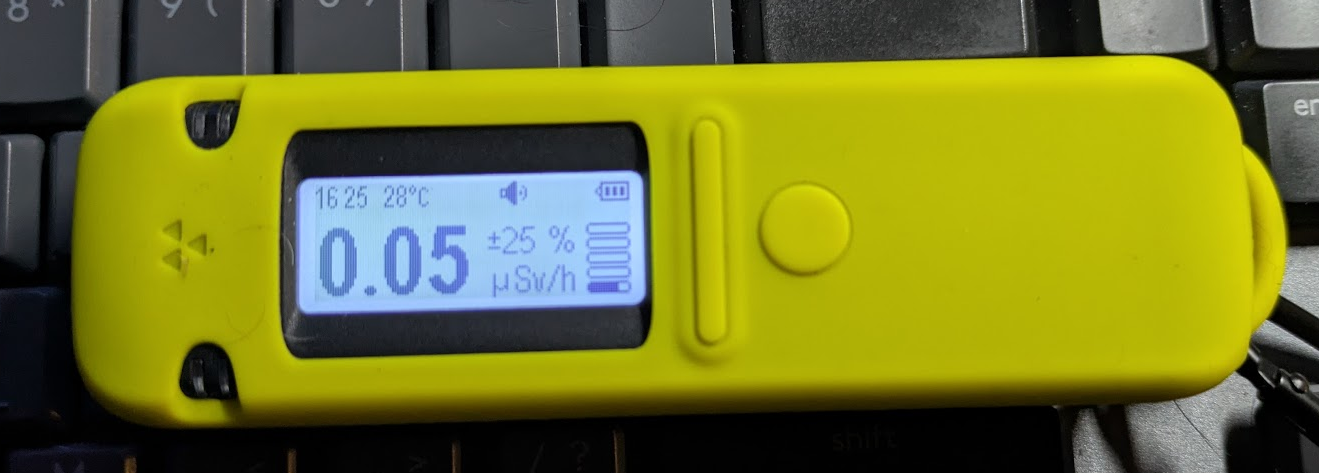
It turns out that the 103’s lower sensitivity makes spectroscopy take longer, but it is less likely to be overwhelmed in the presence of a really strong radioactive source. Lets hope I don’t get to test that out.
While the display on the unit can display a low resolution spectrum, it is much easier to deal with using the Radiacode app on a phone.
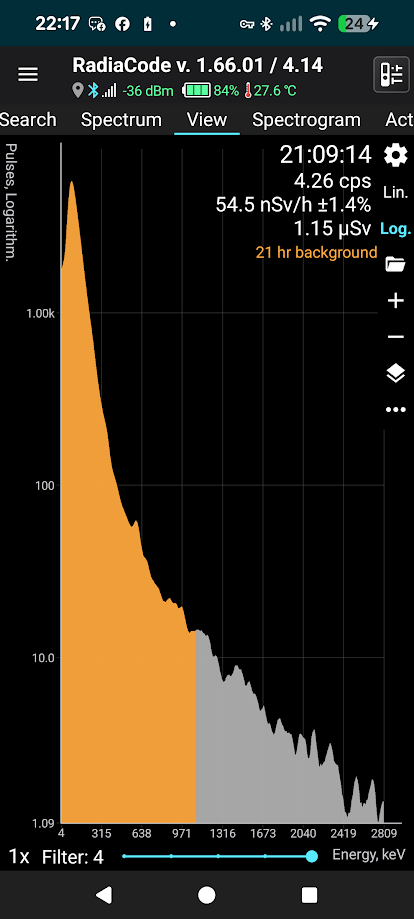
Once I understood some of the basic operating principles, I captured a pretty long background radiation baseline spectrum, 21 hours. The unit uses very little battery power. At the end of 21 hours, it had 89% charge left in its battery. I charged it anyway.
Amongst my many almost skills is TIG welding. I have quite a few tungsten electrodes. Some electrodes, for reasons that I have not adequately explored, work better with small amounts of various rare earth metals in the alloy. One of these, Thorium 232, is mildly radioactive. All radioactive elements are, by definition, unstable. They will radiate whatever particle they are prone to emit and transmute into the next lighter element in their “chain”. From a nuclear physics and quantum mechanics point of view, the decay of Thorium 232 it is a very very slow process. Thorium has a stupidly long half life of 14 billion years, meaning that, unstable or not, the vast majority of thorium in any given sample of the metal, will remain thorium for, in human terms, beyond forever.
Half life is a curious term. It is a statistical rating of how long it will take for half of the atoms in any sample of an element to have emitted whatever their flavor of radioactivity is and transmuted into the next lighter element in their chain. The decay chain of any radioactive element has a lot to do with the structure of the element, how many protons and electrons the nucleus has, how many electrons are in each electron shell, etc. For the Thorium chain, and really any alpha particle emitter, it will decay into something with an atomic mass divisible by four, four being the number of subatomic particles in an alpha particle. Duh, kinda. Next in line from Thorium 232 is Radium 228. Statistically, it will remain Radium for 5.7 years, then beta decay (lose an electron) into Actinium 232 for 6.1 hours, then beta decay into Thorium 228 for 1.9 years.
At this point, it gets into a bit of an alpha rush. Thorium 228 alpha decays to Radium 224 for 3.6 days, to Radon 220 for 55 seconds, to Polonium 216 for 0.14 seconds, to Lead 212 for 10.6 hours. That will beta decay into Bismuth 212 for 61 minutes and we finally reach a fork in the road.
Bismuth 212 can either alpha decay into Thalium 208 for 1.1 minutes, then to Lead 208 for the rest of eternity, or Bismuth 212 can beta decay into Polonium 212 for 300 nanoseconds then alpha decay into stable Lead 208.
Glossing over a LOT of details, generally, the longer the half life, the less radioactive the element is. Thorium 232 is interesting in that it has the longest half life of any element heavier than Bismuth.
I digress.
As mentioned, Thorium 232 is mildly radioactive, an alpha emitter. Alpha particles are not very penetrating. The plastic case and the silicone sleeve on my 103 are way more than enough to completely block alpha particles from getting to the scintillator in the unit. However, some of Thorium 232’s decay chain are beta and gamma emitters, which we can detect. Also, all of these, including alpha particles, can induce xrays in other elements, give us an indirect identification of alpha emitters.
The people at Radiacode are better at the math than I am, so their software knows how to identify elements based on the electron volt energies detected.
Remember thoriated tungsten welding electrodes? This is a post about thoriated tungsten welding electrodes.
I have a small variety of tungsten electrodes for my TIG welder. According to my testing with the Radiacode 103, none of them are thoriated.
So, I ordered some from our favorite abusive uncle, Amazon. I ordered a 3 pack of 2% thoriated tungsten electrodes. It was my own screwup that I ordered 0.040″ diameter rods, which are far too small for my current setup, which needs 3/32″ (0.09375″) rods. As an aside, I am now curious about the use for 40 thousandths electrodes and I will look into that. However, upon their arrival, I found that the large clear plastic tube that the electrode (singular) was in had a hole in the bottom of it that allowed two of the three to escape. They were not in the shipping envelope, so they were lost before shipping. As I’m sure everyone is aware, I doubt the people working in an Amazon warehouse are paid enough or allowed time enough to care if the package something comes in is broken.
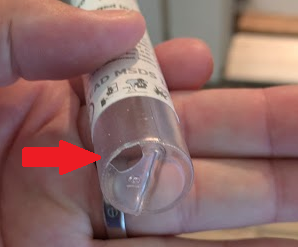
Since these were ordered primarily as something to use specifically to test the Radiacode with, I elected to take my lumps and not deal with returning them (it).
I did find that in the direct presence of this electrode, the Radiacode definitely detected higher than background radiation, but it was definitely not a lot. It took most of 6 hours to register enough peaks in particle energy to identify the Thorium 232 decay chain.
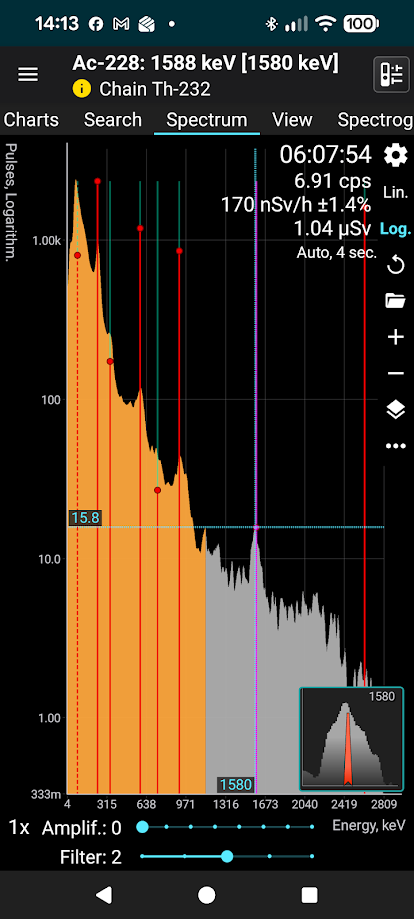
The purple line represents the specific energy level that I am looking at here, which corresponds to the characteristics of Actinium 228, but note all the red lines at various peaks. These are other “fingerprint” energies which ultimately reveal that the spectrum under test is in the Thorium 232 decay chain.
Gathering this spectrum took so long because a single 40 thousands wire sitting directly by the detector does not have a particularly high count of radiation detection events. Today, I wanted to recapture this spectrum, so I broke the otherwise unusable electrode into several pieces, five to be exact, to concentrate the signal on the detector. I was able to get a really good spectrum in about 90 minutes.
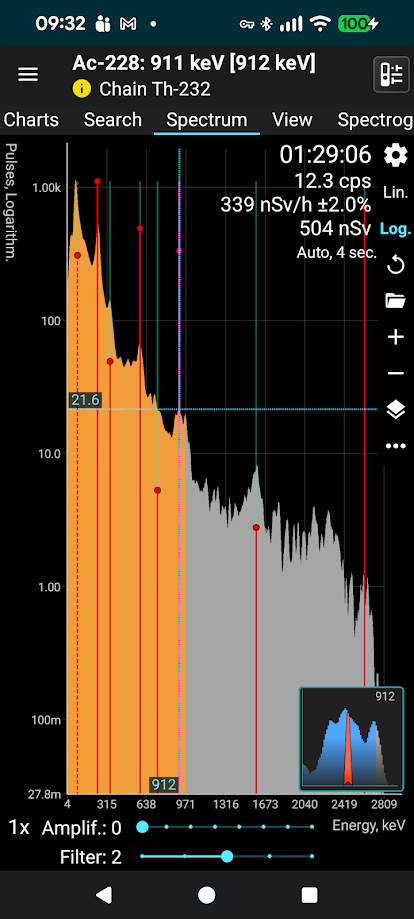
Same basic results, just a little faster because there was more material right by the detector.
Between these two spectrum captures, I had a chance to fly to Virginia for work. For my first trick, I left the Radiacode turned on and in my laptop bag for the TSA security check. Understandably, it was briefly exposed to a fairly high dose of Xrays.
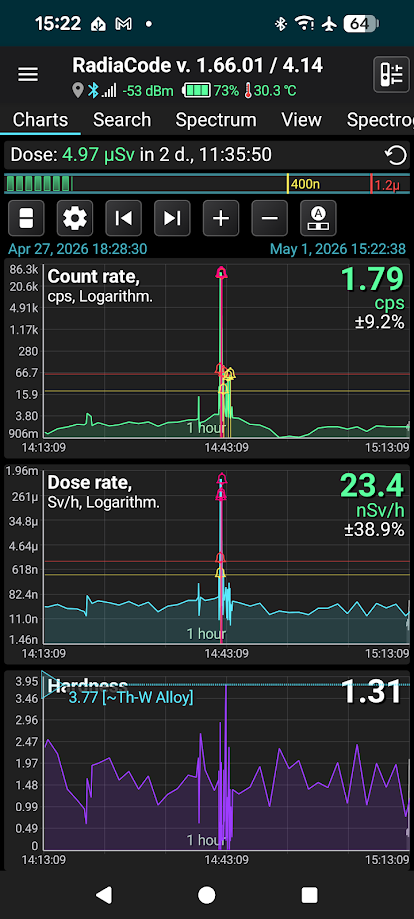
The poor thing was beeping an alarm at me when I retrieved the bag after TSA.
To put them all together for the day’s travel, there is at least double the count rate while in flight. This flight was Dallas to Orlando then Orlando to Norfolk.
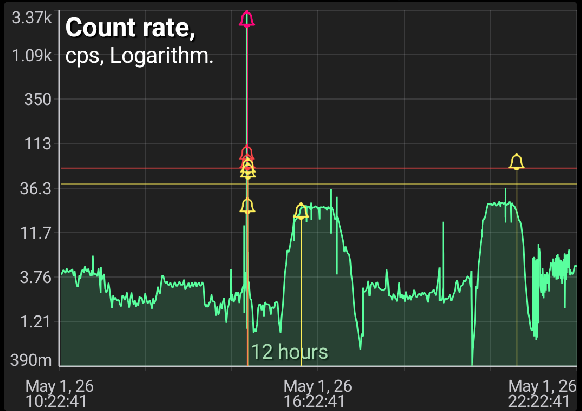
Note the gradual slope while climbing and descending. There are also noticeable dips that appear to be while I aboard, but we were on the ground. I am not sure what causes that.
For some reason, this historical data does not show the similar dose rate. I am certain that I dinked with some setting that broke that, some scaling factor I would guess. Shrug.