It has been a bit more than a year since I posted the October 2024 eclipse story. I have not been super active in astrophotography, but I keep informed via YouTube and Discord.
Last night was the first astro attempt for several months. Short version, skies were mostly clear except about where Polaris is, so polar alignment did not happen within the hour or so before I gave up on that.
Instead, I turned to the almost full moon. (Yes, even with a full moon, I was going to try for a nebula somewhere) I had recently looked up some tips on lunar photography with my Redcat 51 and wanted to give it a try. The short version of that story is that I was able to snap a couple dozen frames. The previews or thumbnails looked promising, but the actual images were really blown out 🙁
Discussing this with friends in a Google chat, it occurs to me that, while astrophotography can start pretty cheap, especially if you already have a DSLR, the vaguely defined rules of time-effort-money apply. You can generally save one, but not all three.
Much of this chronology was discussed in an earlier post, but this time, the theme is the costs.
In my case, I started, with no concept of hobby astrophotography, with a Canon EOS Rebel T6 that I bought from Meh in 2017. Meh frequently has weird deals. I think they basically buy closeouts and get what they can for them. Sometimes it’s some protein bar, sometimes is a backpack, sometimes some oddly specific smart home light bulb. Almost always something that probably didn’t sell somewhere else. I’m not sure why they had a truckload of not really that out of date Canon cameras, but it was a bundle that would be $550 retail that they were selling for $340-something. For me, it was really intended to replace my film photography hobby from decades earlier. I did some minor accessorizing, such as getting a 70-300mm lens, a 500mm reflector lens which is actually not a great lens, a tripod, etc. I would take a number of decent pictures with it, but it didn’t really light me up until 2021 when I discovered the decoder ring that was Nico Carver’s “Nebula Photos” YouTube channel. I am not sure how the algorithm linked me up with astrophotography, but it did. The thrust of the video was how to do this on almost no budget, assuming you already had a DSLR camera.
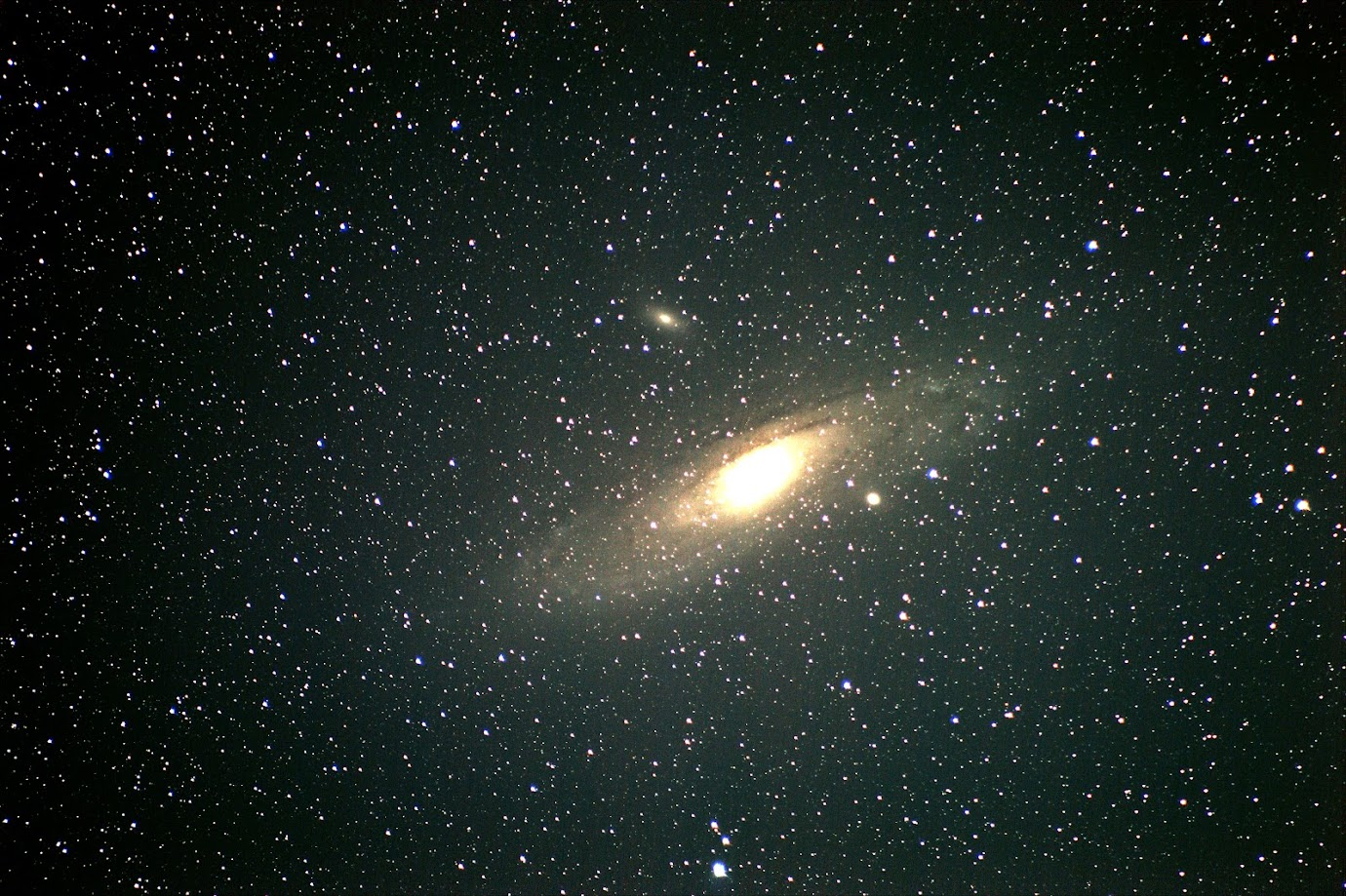
Using the Rebel and a tripod, I followed the advice in probably this video to capture a very basic but not terrible picture of the Andromeda galaxy. This was untracked, stacked with Deep Sky Stacker and tweaked with GIMP. It was fun, but untracked, with a not particularly awesome 300mm zoom lens meant short exposures. Still, I was hooked.
The first dedicated astro gadget was a tracker, the iOptron SkyGuider Pro. It was $488 in July 2021. Now I could do much longer exposures and generally had better luck. I think it took a couple of sessions to get a decent Andromeda.
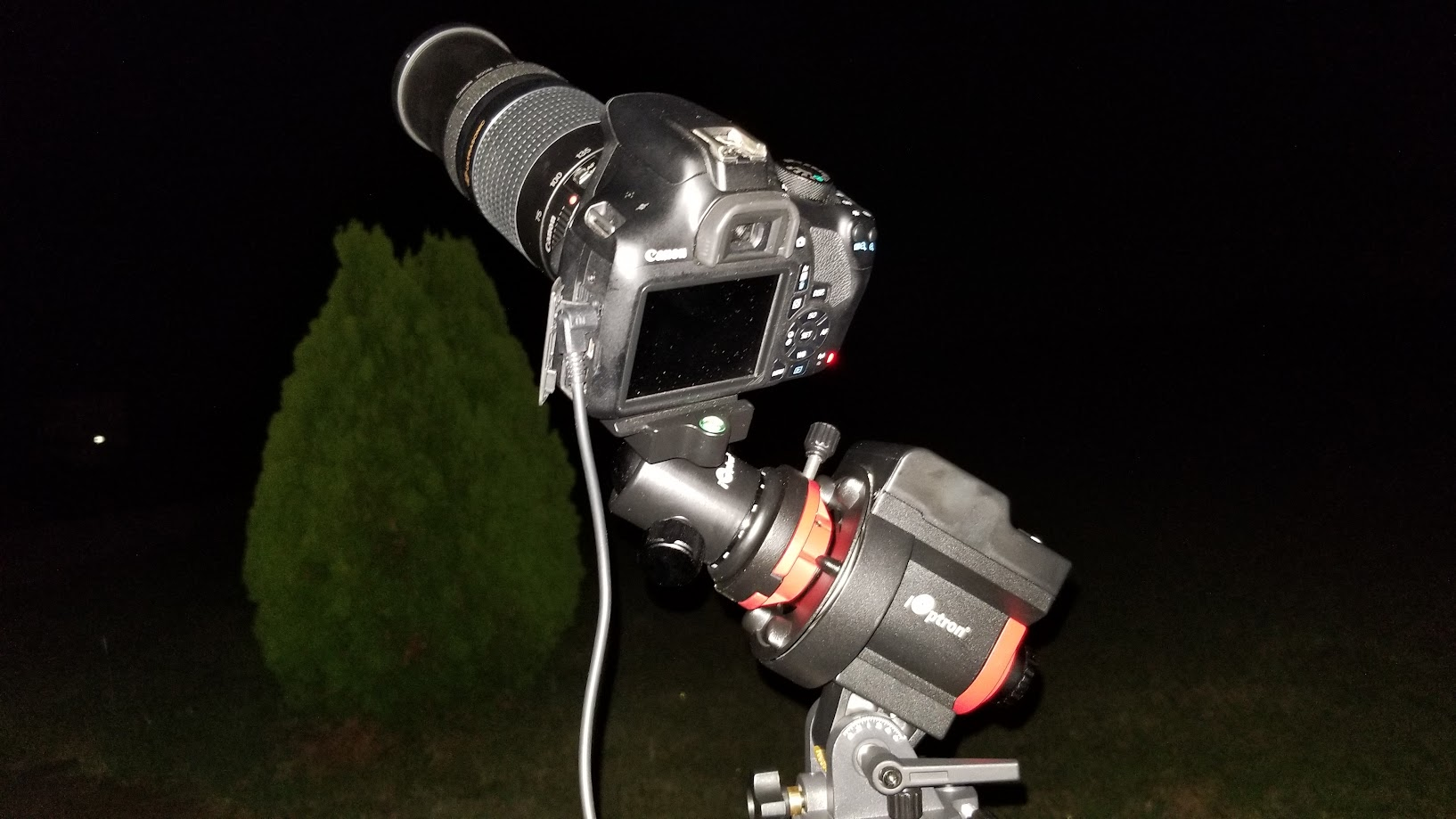
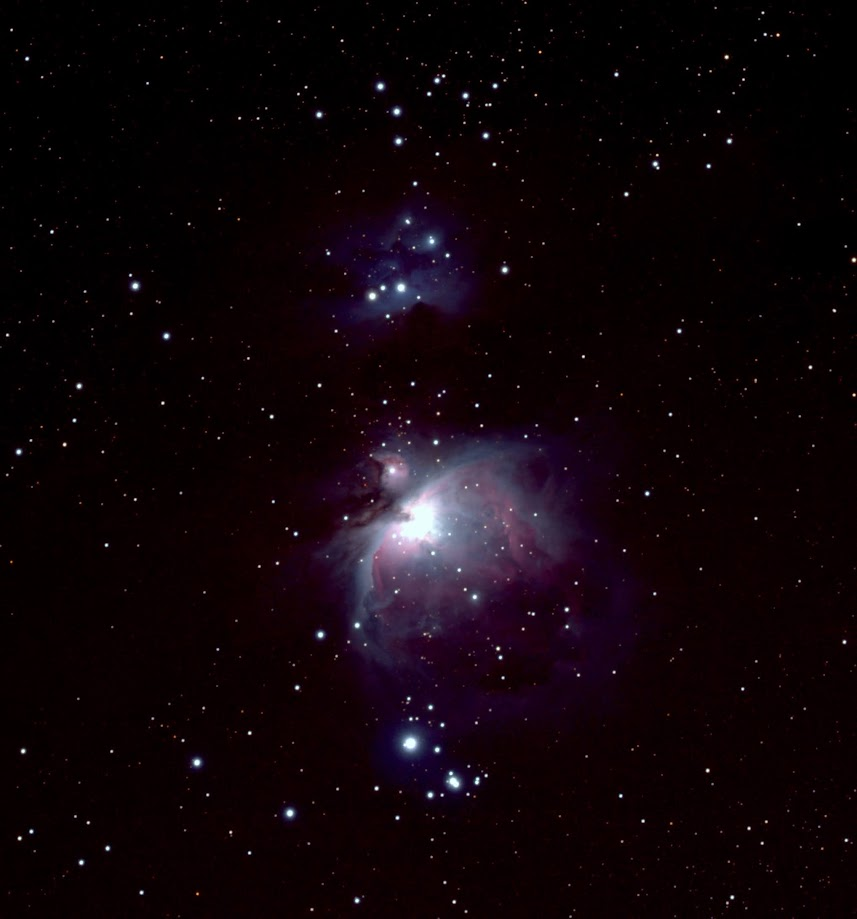
I also seem to do my upgrades in the summer and maybe July specifically. July 2022 brought the really big upgrade to the William Optics Redcat 51 telescope, the older one with the helical focus ring. It was $844, which for me was quite the sphincter pucker. I would not have much to show for it until January 2023, when I got my most favorite capture thus far, the Orion Nebula.
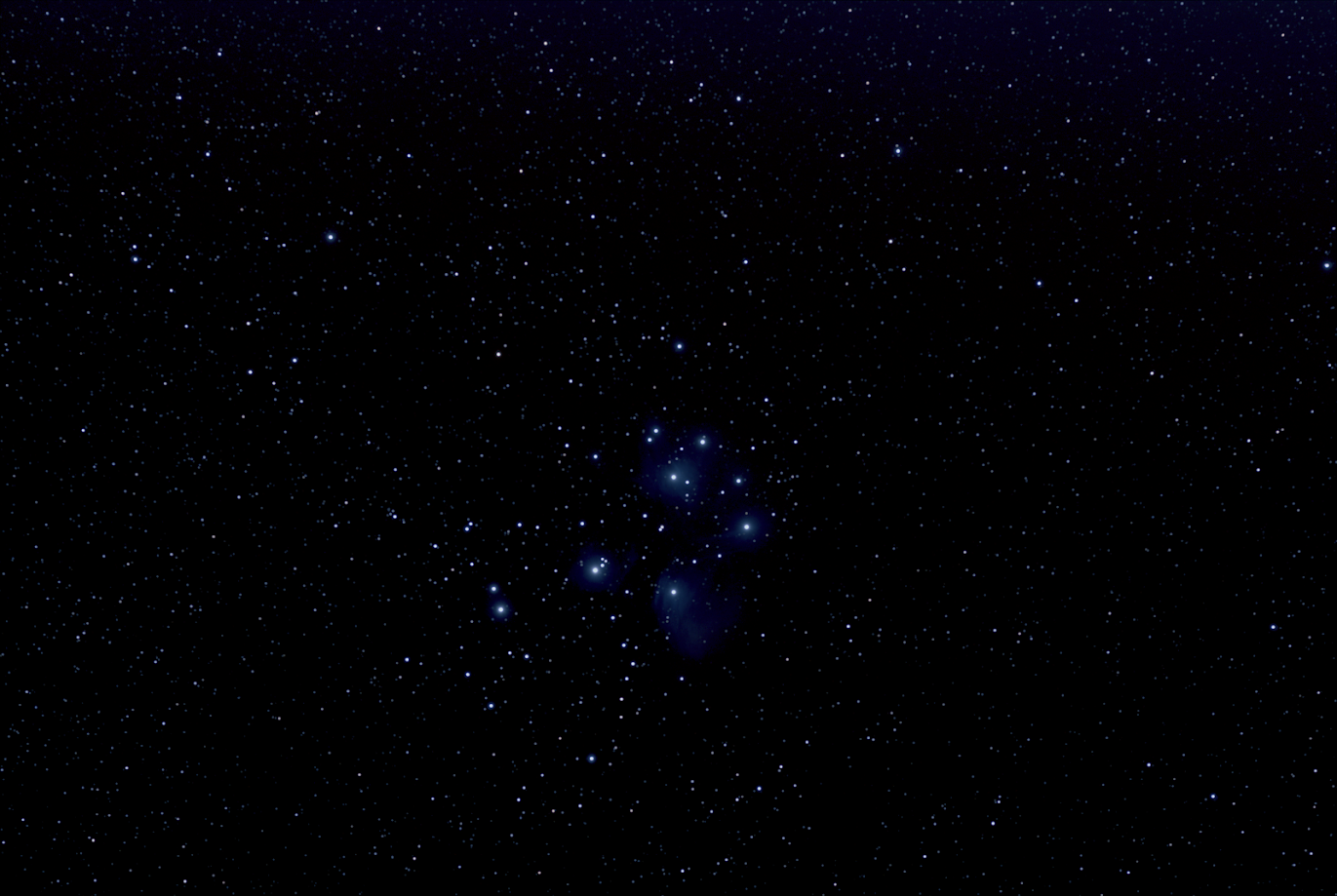
January 2023 also got me very nice picture of the Pleiades cluster.
The heavier Redcat was slightly more sensitive to my plain Jane tripod. It was a nice enough tripod, just not as solid as was needed for astro work. I ordered the iOptron tripod to fit the SkyGuider Pro in November of 2022, for just over $100. It was backordered and didn’t ship until January 2023.
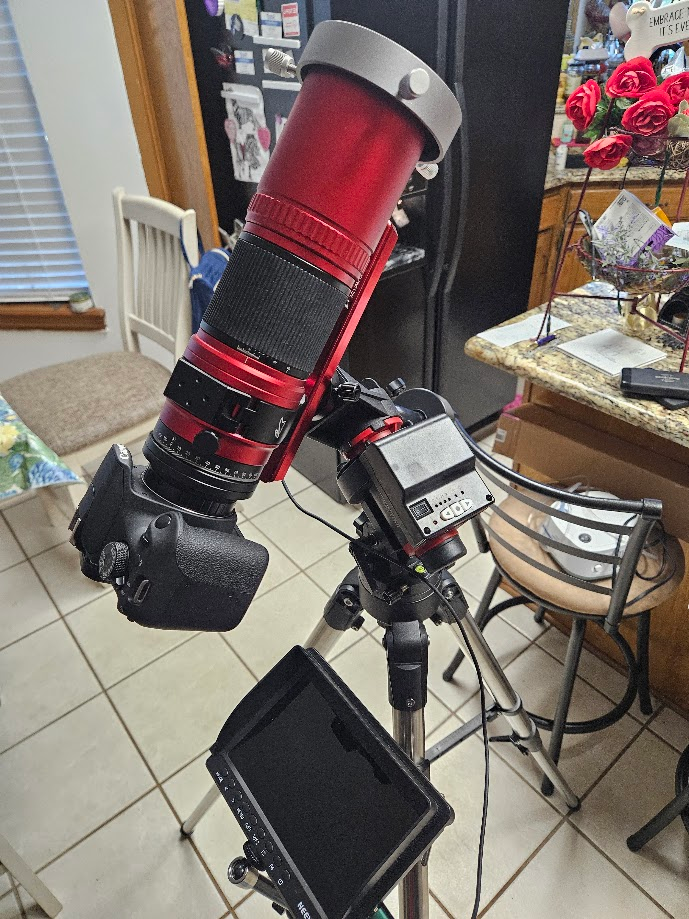
The rig was pretty stable for a while. This is is the basic rig used for the October 2024 total eclipse. The external monitor was very nice for the eclipse, keeping me from bending in unlikely directions to view the camera screen. I don’t often go to the trouble of setting it up.
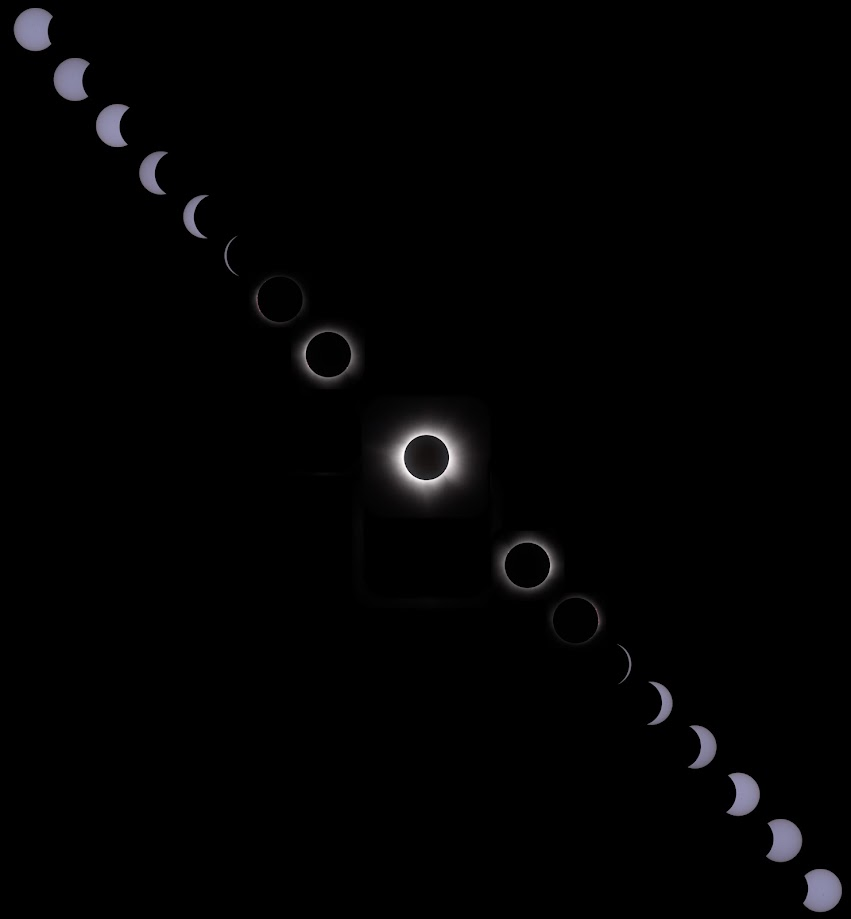
I took a bit of poetic license in assembling this composite. There were some passing clouds between third and fourth contact, so I used the sequence from first contact to totality, then mirrored them for the bottom half of the pic. I have also just noticed that this specific version shows an artifact of my manipulation. I have a version that is clean. 🙂
As mentioned in a different post, I picked up a Canon EOS Rebel T5 camera body. It was just under $100 from Adorama. I have used it mostly as a “replacement” for the T6 for casual photography, but I have always thought I might send it off for a full spectrum mod.
From here, I spent a good deal of time and some money on storage, mostly in the form of knock-off Pelican cases, some from Harbor Freight, some from Amazon. I currently have a case that holds the Redcat and the stuff attached to it, a case for the SkyGuider Pro, a biggish rolling case for most of the accessories and the camera itself. The accessories have not specifically been inventoried or priced out, but it’s stuff like battery eliminators and chargers for the Canon cameras, intervalometers, filters, cables, cable management stuff. Probably a couple hundred bucks worth of stuff, but I haven’t gone to the trouble to add them up. I predict that I probably will someday.
The next upgrade was something that I had watched for a long time and nearly purchased several times, a ZWO ASIAir controller. I ended up with the ASIAir Plus with 256GB of storage. I already liked using laptop software to control the capture, even if I had only done it a few times. The idea of being able to set up the rig and retire indoors, away from winter’s chill or summers insects was very attractive.
Most of the astro specific gear I have purchased thus far was from High Point Scientific, or sometimes Amazon, but the ASIAir came from B&H Photo. The controller was $350, but the whole order came to about $500 because of accessories, like a dovetail clamp for the ASIAir and some high performance SD cards. As befits my habit, this was ordered in July 2025.
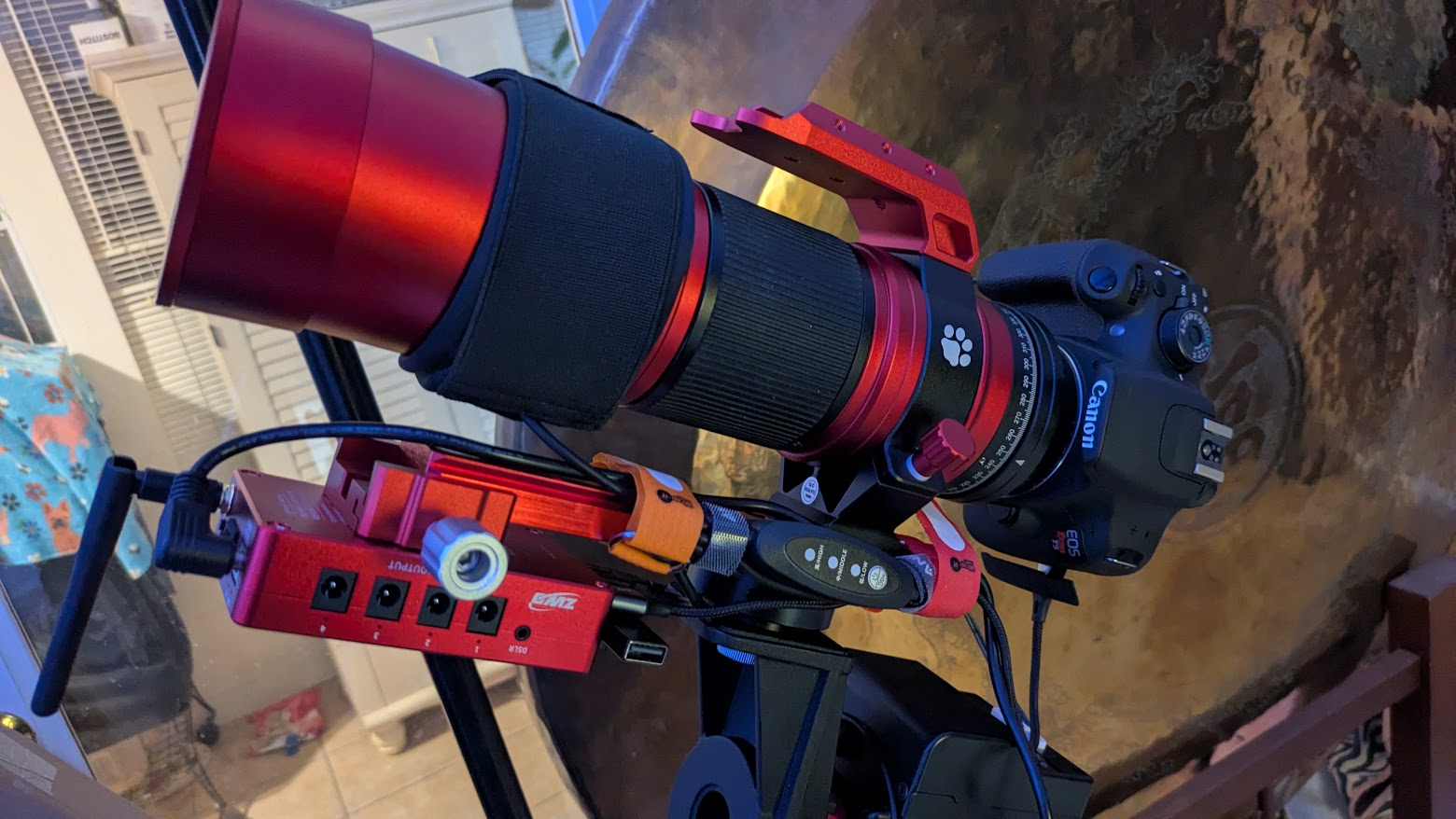
It would be February of 2026 before I actually tried to capture anything using it. My stepdaughter and her hubby came out, ostensibly to see the planetary alignment, but we wanted to try to get some nebula or another while they were here. There was a bit of a learning curve with the ASIAir, but the ultimate failure of the capture session was down to bad viewing conditions. Often, the world fails to meet my expectations.
Work has kept me busy enough to not have much astro time since then. However, it’s July again, so…
Although I haven’t specifically had any *problems* with tracking, I have still been low-key shopping for a guide camera to further improve tracking and maybe up my exposure times another notch. Longer exposures mean more light on the sensor and more light means improved signal to noise ratio. Some guiding options are actually not terribly pricey, at least compared to $500 for this or $800 for that. It should be obvious that plan won’t work for me.
I weighed what I was willing to spend on a payment plan vs what was available. In the long run, I have decided to shrink the rig a little more by going with a smart camera, the ZWO ASI585MC-Air. I found an open box deal, so it came to, you guessed it, about $800, including an accessory or two. The ASI2600MC-Air, with its huge 21MP sensor, would have been my preference, but I wasn’t ready to pay nearly double for it.
This little monster has an 8MP cooled color camera and a 2.1MP guide camera that both sit in the same focal plane, eliminating the need for a separate guide scope and camera and the attendant cabling. Furthermore, it has an ASIAir controller built in, eliminating the ASIAir controller, the Canon camera and their power and control cabling. All in all, it should be a clean and compact deployment.
On paper, the 8.1MP ‘585 sensor is arguably less impressive than the 12MP sensor in the Canon, but the ZWO camera has two feathers in its cap. First, the WxH resolution is smaller, but the pixel size is significantly smaller, meaning a sharper image in that resolution. A Canon image cropped to the same width and height would still not be as sharp. Also, it doesn’t have the kind of infrared filtering that a DSLR has, making it better suited to the red and near infrared from emission nebulae.
On that subject, after I placed that order, I remembered that I wanted to get a dual narrow band filter with it. Our property used to show as Bortle 4 on the common light pollution maps, but in the last year or two, that has gone up to Bortle 5. That, and we have sodium and mercury lights in the neighborhood, especially including a sodium light on our property. These and my interest in emission nebulae have informed a desire to try out a dual narrow band filter. I ended up ordering an SVBony 7nm filter from Amazon. So there went my open box savings 🙂
The filter will probably arrive Wednesday, but the camera will be Saturday.
As for any future upgrades (and lets not pretend I won’t) I think it will either be a mount upgrade, which would require some kind of a go-to capable mount or, perhaps cheaper and more likely to come first, an electronic focuser. Focusing the Redcat, with the helical focuser, can be tedious. Automating that should help minimize setup time. I don’t really see a need to change telescopes to something with a rack and pinion focuser. Although… if I were to do that, it would also have to be an upgrade otherwise. Just getting the newer Redcat 51 wouldn’t make sense, but a telescope with a bigger objective *and* rack focus…
Stay tuned.