It’s been a couple weeks since I updated the ol’ blog, but I’m still doin stuff.
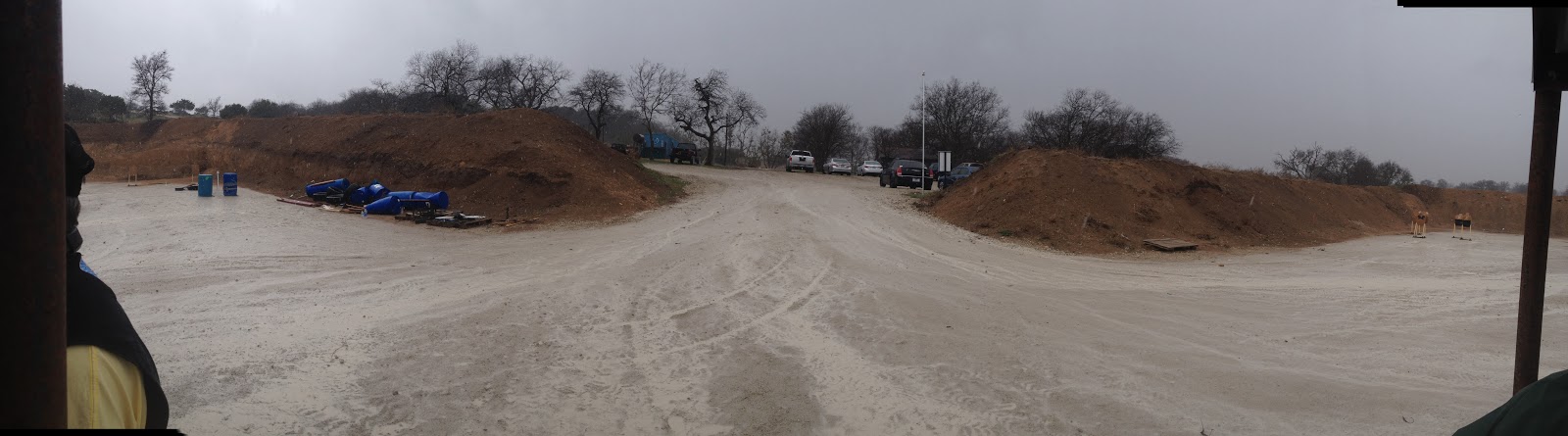
My oldest friend from way back in 7th grade (and that was a while back) came to visit. He caught the last stage or so of the Friday IDPA match at Lone Star. Saturday morning, we set up three IDPA targets out back and shot almost every firearm on the premises, paying special attention to my Glock and my 1911.
Early in the afternoon, another old friend/coworker and his wife came out bearing rifles, pistols and even a bow. The rifles were sighted in and pistols and bows were shot by all. The weather gave us a start, but it let us be in the end.
Sunday, we cleaned and lubed all the very dirty pistols and after my friend headed for home, I set up my press to load 40S&W.
During the course of the following week or two, I loaded up about 150 rounds featuring 165gr RNFP polymer coated bullets on 4.2gr of Hodgdon Titegroup. The goal is a fairly inexpensive soft recoil load for use with IDPA.
4.X grains of TiteGroup is apparently the bottom limit for reliability with the Lee Adjustable Charge Bar. The published range is down to 0.28cc, but I could not get it to throw consistent charges with it turned down that small. I would have expected the extra fine grain size to have actually been less troublesome in small volumes, but that was not what I was seeing. I ended up using the 0.37cc orifice in the standard discs to get a rock solid 4.2gr charge.
The other problem I had was much trouble getting the finished rounds to case gauge well. They kept not quite dropping into the gauge block. I found that increasing the flare in the case mouth helped quite a bit. With the smaller flare, it was much more likely to shave a bit of polymer and lead off the seating bullet. This shaved material ends up on the case mouth and generally prevented the cases from fitting the case gauge.
A few of the rounds were actually a bit oversize at the head end of the case. 40S&W brass takes quite a beating in some pistols, most famously, but not necessarily deservedly, early generation Glocks. To help feed reliability, the chambers are a little oversize, which lets the brass stretch a little more. Marry that to some high pressure loads, and some 40S&W cases can be a little swollen at the head.
I had an earlier chambering issue which was incorrectly blamed on this phenomenon, so I ordered an undersize resizing die. The earlier issue turned out to be inadequate crimping, but I still had the die and some of this last batch of brass is indeed a bit large at the head, so I used the undersize die and addressed that.
Even with all that, they still didn’t often gauge right. I wanted to try the Titegroup loads, so I had 100 rounds of “close enough” ammo to take to the match on Thursday. It was during the day Thursday that it dawned on me what was causing the issue. Many of the rounds had scrapes up on the curve of the bullet. Bingo! They wouldn’t go into the gauge because the gauge was accurately reflecting the depth of the chamber and the engagement with the rifling. I simply wasn’t seating them deeply enough.
Sure enough, I did have two occasions (both caught on video) where my over long ammo jammed the pistol into almost-battery. One was at the end of a stage, so it didn’t cost me any time. The other, not so serendipitous.
The match was fun. I had my GoPro on a chest rig. I suspected that the chest view would be of limited value with pistol shooting, and I was right. Stage 1 had an interesting bit wherein for the last three targets, the shooter needed to shoot from very low. Most shooters laid on their side to take these three. Somehow, I had the camera in the wrong mode and thus did not capture that stage. The HD version is here.
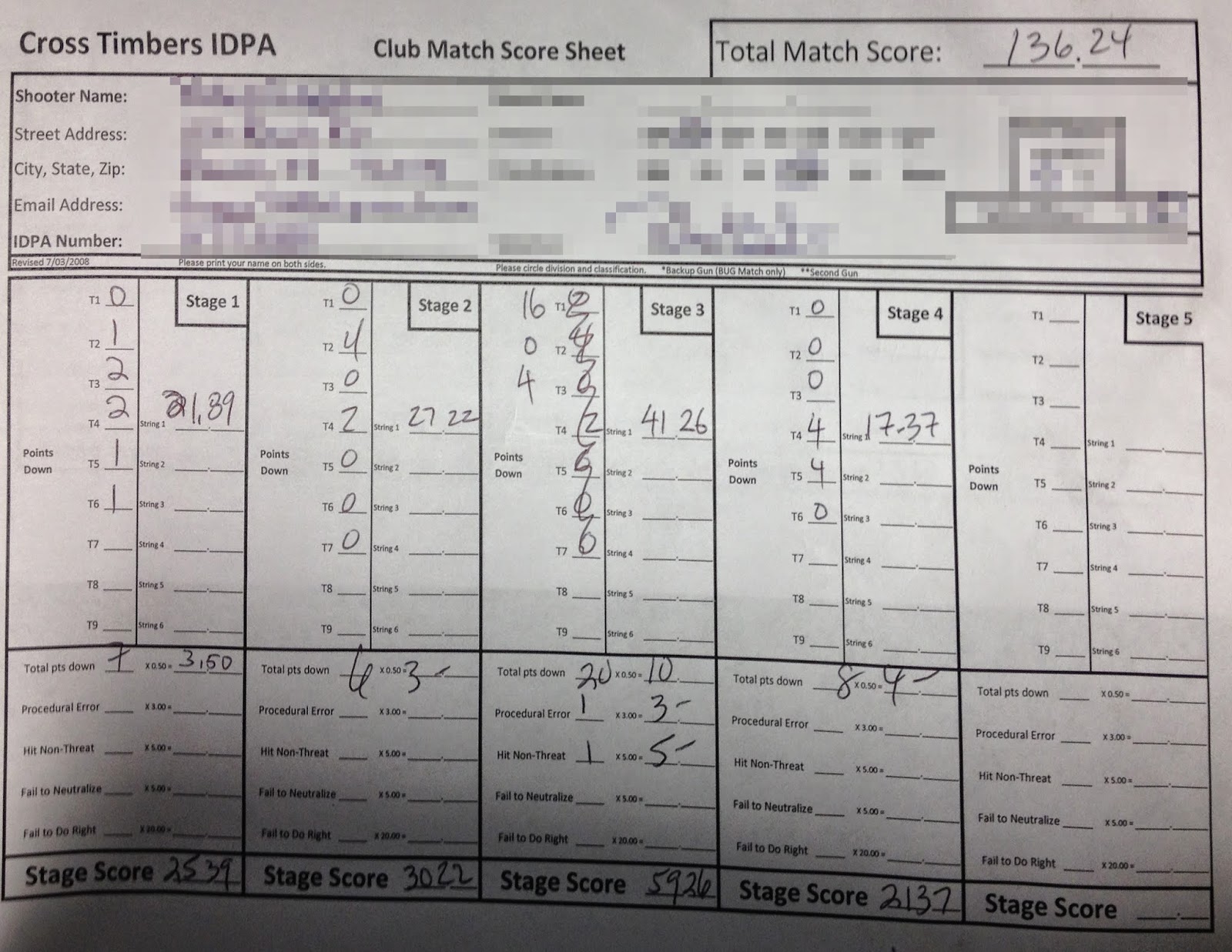
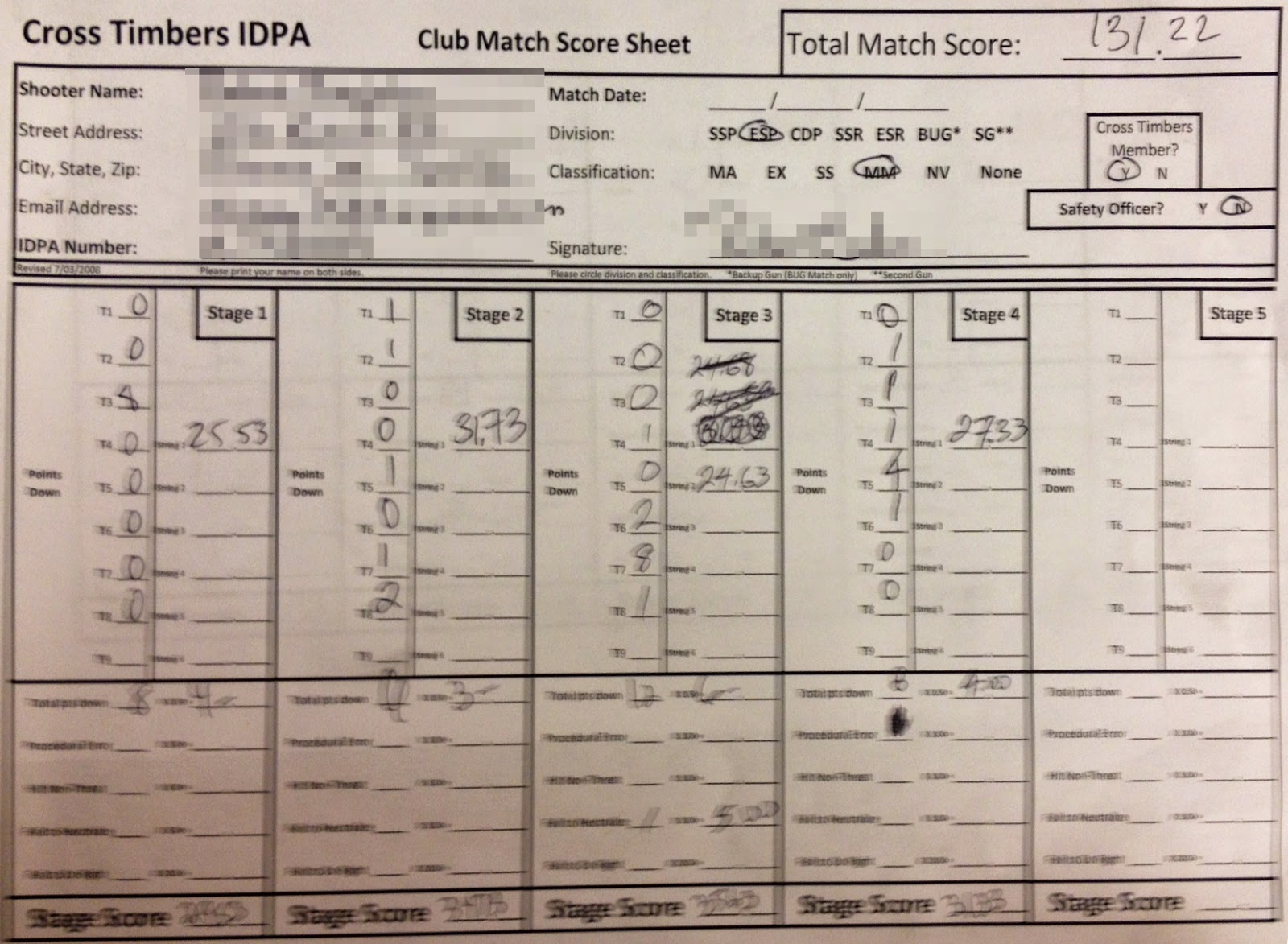
Scores were not bad, with the exception of stage 3’s jam. In fact, stage three is really the only one much worth talking about.
The stage description was easier to do than to describe. There were two shooting positions and three targets. At the start, you have two magazines sitting on a barrel at P1 and one at P2. At the buzzer, load the pistol and place three shots on any two targets. Remove magazine (you could stow the mag or leave it on the barrel, but it wasn’t empty, so you couldn’t drop it) and move to P2. Load the pistol, place three shots on two other targets. Remove mag, move back to P1, load pistol with the unused mag and finish with three shots on the remaining two targets. The final goal is six rounds in each of three targets, limited to 18 rounds, and oh yeah, can’t shoot the same target twice in a row.
In this dance, my ammo jammed up on the first shot of the second target. I (eventually) cleared the jam and kept count, placing two more shots on the proper target. Moved to P2, did that, moved back to P1 and somehow only placed three shots, skipping the last target. Consequently, that cost me 3 misses and a procedural error for not fully engaging a target with the required number of rounds. I also managed to hit the Non-Threat on the left target. Twice. It was just the edge of the Non-Threat, not that it matters 🙂
I got home after the match and while the horsies were munching their late dinner, I adjusted the bullet seating die and loaded a handful of rounds that all gauged perfectly. I may consider putting the regular resizing die back since the last 1000 or so rounds didn’t actually have that problem.
Maybe I am beginning to actually listen to my own mantra, sloooowww dooowwwwnnn. I did pretty good on this match and I think it’s largely due to pacing myself within my abilities 🙂
I think my TruGlo TFO sights helped, too. They are REALLY vivid in the nice bright lighting of the range at Lone Star and my old guy eyes like them.
The scoresheet is almost boring….
The scores submitted omitted the FTN on stage 3, making my total match score 124.22. This was later corrected. It changed my score, but not my position.
On stage 3, the raw time scratchout was due to a low charge round. When that one went pop instead of boom, the SO called a stop, fearing a squib. We checked the pistol and it turned out not to be a squib, and they let me reshoot the stage. Turns out that was good because I clearly recall failing to get the first two targets in the required tactical sequence first time through.
One stage at this match has caused much post-match discussion concerning a start while seated with a COF description requiring the engagement of 5 targets while seated then move to the next shooting position. In practical terms, I handled it by placing all the required shots, taking one extra shot at the last target, then reload while on the move to the next shooting position. However, fairly recent changes to the rules make the precise time at which on can or cannot move or begin a reload a matter of contention. I will see what comes out of the discussion and just understand that I may or may not get a procedural error which I may or may not deserve if reloading while moving or seated.
In any case, in my tiny corner of the match, 124.22 was enough to have been top ESP Marksman (of three) and while overall scores are NOT tracked or compared, my time was right in the center of that list.
I usually post a pic of my scoresheet and analyze each issue, but as this was my first low light match, a lot of that doesn’t really compare with other matches. It’s not that I feel any embarrassment over it. I will reveal plenty of what went wrong. I’m just not going to waste the bandwidth with a pic of it. Total score was 172.28, earning me the lowest place in ESP.
Much more important to me is that it was a LOT of fun! Many present had never shot a low light match and as pointed out before we even started, a lot of what we would be doing was experimenting to see what works and what doesn’t. In that, I learned that I do best if I shoot strong hand only and wield the light well away from the pistol, keeping light trained downrange and using my night sights in relative darkness.
Numerically, my performance had an interesting trend. Each stage scored kinda alike. The four stages were 19, 23, 23 & 20 down respectively, an average of 21 down on each. Each of the four stages had either one Fail to Neutralize or one Hit on Non Threat, each worth 5 seconds. Even raw stage times were remarkably consistent, 24.71, 29.58, 34.15 & 21.34 for an average of 27.45.
My worst was probably Stage 3 where, somehow, I completely missed three shots on the same target. There’s nothin’ that makes you feel good like 15 down and FTN on one target! There were two targets in a tarp tunnel with a Non-Threat between them. There was a ficus tree soft covering both targets, but mostly covering the one on the left. My miss, however, was the one on the right. I engaged it. I just didn’t get any on it. I didn’t get the Non-Threat, either. Shrug. The rest of the stage was 1’s and 2’s. One issue that many people had with that part of that stage is that the tarp was hanging so that the edges were likely to be fairly near the gun. Muzzle blast frequently sucked the tarp into the line of sight if you covered with the gun near the edge. Those who stepped more forward but still remained in cover had less trouble with the tarp.
I had trouble with low cover last week. I did ok this week, even fumbling with the light.
In Stage 4, I finally figured out what worked for me, light-wise. For this stage, start was with pistol and light on a pedestal, four targets to get three rounds each. At the buzzer, pick up light and pistol and proceed. I picked up the light, turned it on, placed it between my left pinkie and ring fingers, facing off the back of my hand. I kept it low and shot (at) the first two targets on the move to P2. This felt pretty good and as planned, left me with fingers and thumb for the reload without parking the flashlight anywhere. I flat nailed the Non Threat, then proceeded to place only two on the first target and only one shot of three on the other. Regardless of my mental checklist to the contrary, I was shooting faster than I should have been. Once at P2, there were two more targets to take 3 rounds each. On on the 11th shot, I expected the slide to have locked open. When it didn’t, I tried and it just clicked. I reloaded and slingshotted the slide and took the last shot. I returned to the previous cover position and tried a makeup shot that apparently still missed.
I am looking forward to the next one!
We also have match in Weatherford tonight and I’m late to leave!
At the request of Stephanie, the Lee CSR I had been emailing with, I sent them the two broken toggles and the peripherals connected to them for inspection, along with a package of documentation about the circumstances for each break and (this is a hazard of any such correspondence with me) my theories as the the weaknesses of the design and what I would do to correct them.
Since they had already replaced my original toggle and had shown great interest in the problem, I was satisfied and considered the matter addressed, at least until such time that I might experience another breakage and I now have a spare toggle set on hand if that happens.
This morning, however, I received another email detailing an order for all the parts I had returned, zero cost, and under customer notes: “REPLACED AT NO CHARGE”. So now, I will have three sets of toggles for spares!
Tonight’s local IPDA match at Winchester is a milestone one for me. The first match I was there to see was a low light match. For safety reasons, new shooters are not allowed to participate in such matches, so I was limited to observing, but it was a very cool thing to see and I was hooked. Tonight, I get to shoot in one!
Always happy to have a good excuse to get a new toy, so I shopped a bit and got a StreamLight ProTac 2L. This thing is about the size of the old Mini Maglight, maybe smaller, but about a million times brighter. The specs list the high setting as 260 lumens. It has multiple modes accessible by pressing or double/triple tapping the switch. These modes are also programmable to a degree. I set it to menu 3, which has low (13 lumens) for first choice and high (260 lumens) for second choice. So, to count scores and navigate, I just turn the light on. To shoot, I double tap it.
I have practiced a bit with drawing the pistol and the light. I have not stumbled across a graceful way, especially if a concealment garment is required, but I can do it safely. The other juggle will be magazine changes. If the rules dont preclude it, I will try to retain the light as I swap magazines, but I may need to stow the light temporarily. I am prepared to work with either method.
For the Thursday night match, I shot the 40S&W out of the Glock with the new sights installed.
Generally, it felt like I could find and align the sights faster, when I slowed down enough to do so. 🙂 They weren’t as bright as I had hoped in the indoor range. I will check them out outdoors this weekend. All in all, I am not at all disappointed in them.
Other than the shockwaves and burnt retinas from the Power Pistol muzzle flash, I had no ammo trouble at all, not a single hiccup. They are a lot hotter than they really need to be, duh. The same 155 gr bullet over 7.0 grains of Power Pistol almost makes major power factor out of the 3″ barrel. I loaded these before I was really involved in IDPA. My next round of competition 40’s will be a bit softer.
Stages were kind of similar to each other tonight. The first two involved downloading to 6 rounds, either advancing or retreating on the first one or two targets then taking four other targets from covered positions. Stages 3 & 4 were essentially the same stage for minimal reset time, but instead stage three was all shots weak hand only and stage four was all shots strong hand only.
In analyzing the scoresheet, I see two things… Neither of the single hand stages had procedural errors. I think that is a directly result of SLOWING DOWN to shoot.
I don’t have a sight pusher tool. Maybe someday, I will want one. For now, I just want these installed and I foresee leaving them there forever, so at lunch I took the pistol to a nearby gun shop where they were able to install the sights while I waited and for less than I was quoted on the phone. 🙂
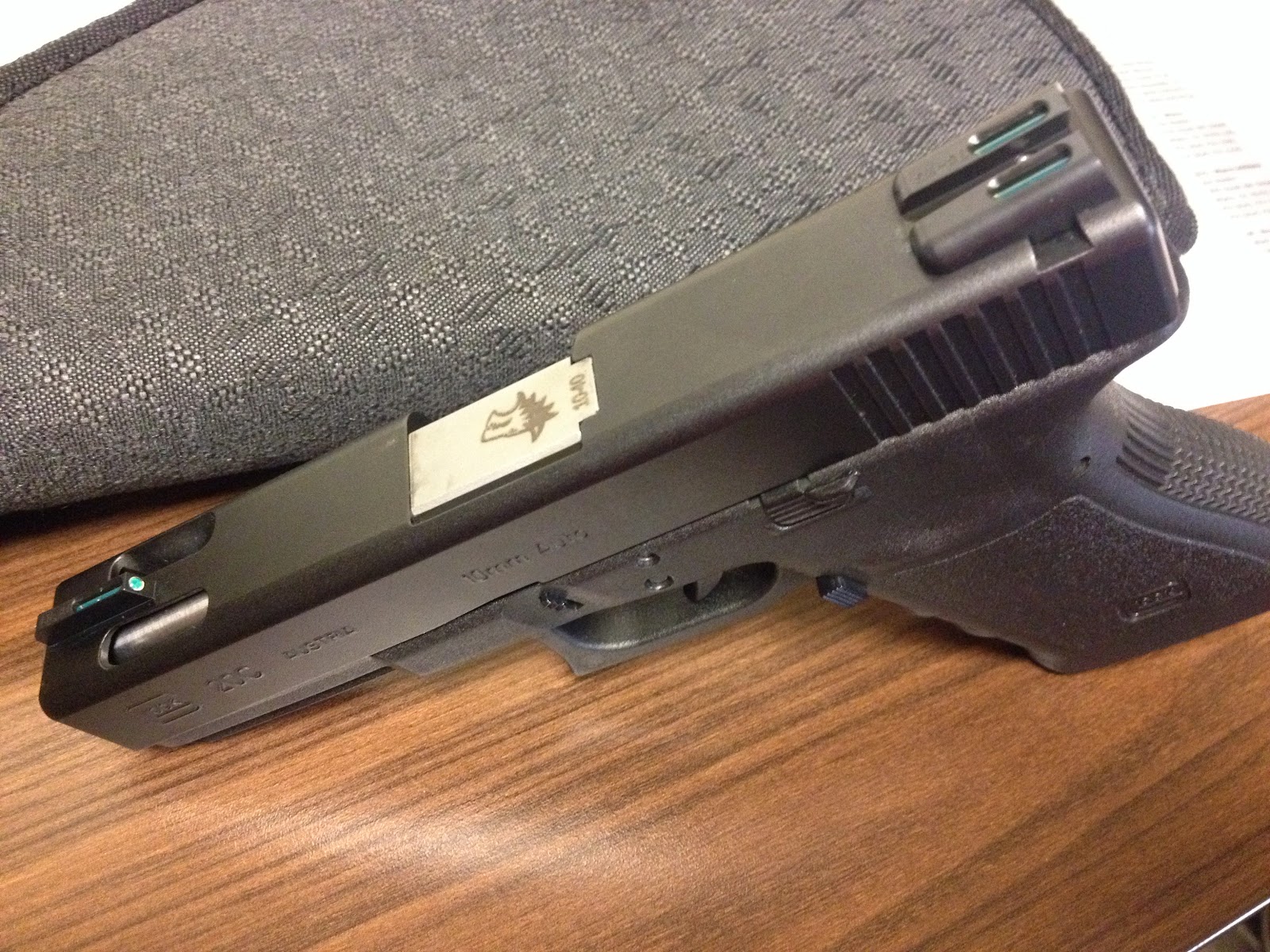
Its hard to get a decent picture of the sights with the iPhone, but the dots are pretty bright. They were REALLY bright out in the sun. The real test will be at an indoor range.
I also got a stainless steel guide rod. IDPA rules ( 8.2.2.2.U ) allow replacing the guide rod with one made of a “material that is no heavier than stainless steel”. I’m not sure if the stainless guide rod will be any measurably better than the plastic one any more than I think a tungsten one would be better than stainless. It does cycle with slightly less spring noise and it looks really nice next to the stainless barrel.
That makes it pretty much official. The only thing left to change out is the trigger itself and I don’t really have any specific plans to do so. I might put on the Talon skate tape grip treatment. I have it already, but haven’t put it on. The Talon grip works pretty well on the Kahr. I also have an extended magazine release that I may or may not go to the trouble to install. Otherwise, I think I am done modifying this pistol.
It is a Generation 3 Glock 20C. I have the original barrel, a stock 10mm Auto non-compensated barrel and a Lone Wolf 40 S&W conversion barrel. I have three stock magazines. I have installed a 3.5 pound trigger connector and polished the trigger rub points. I have installed an “extended” slide release and extended slide lock. Today, I have added a stainless steel guide rod with a stock weight 17 pound spring and TruGlo TFO sights.
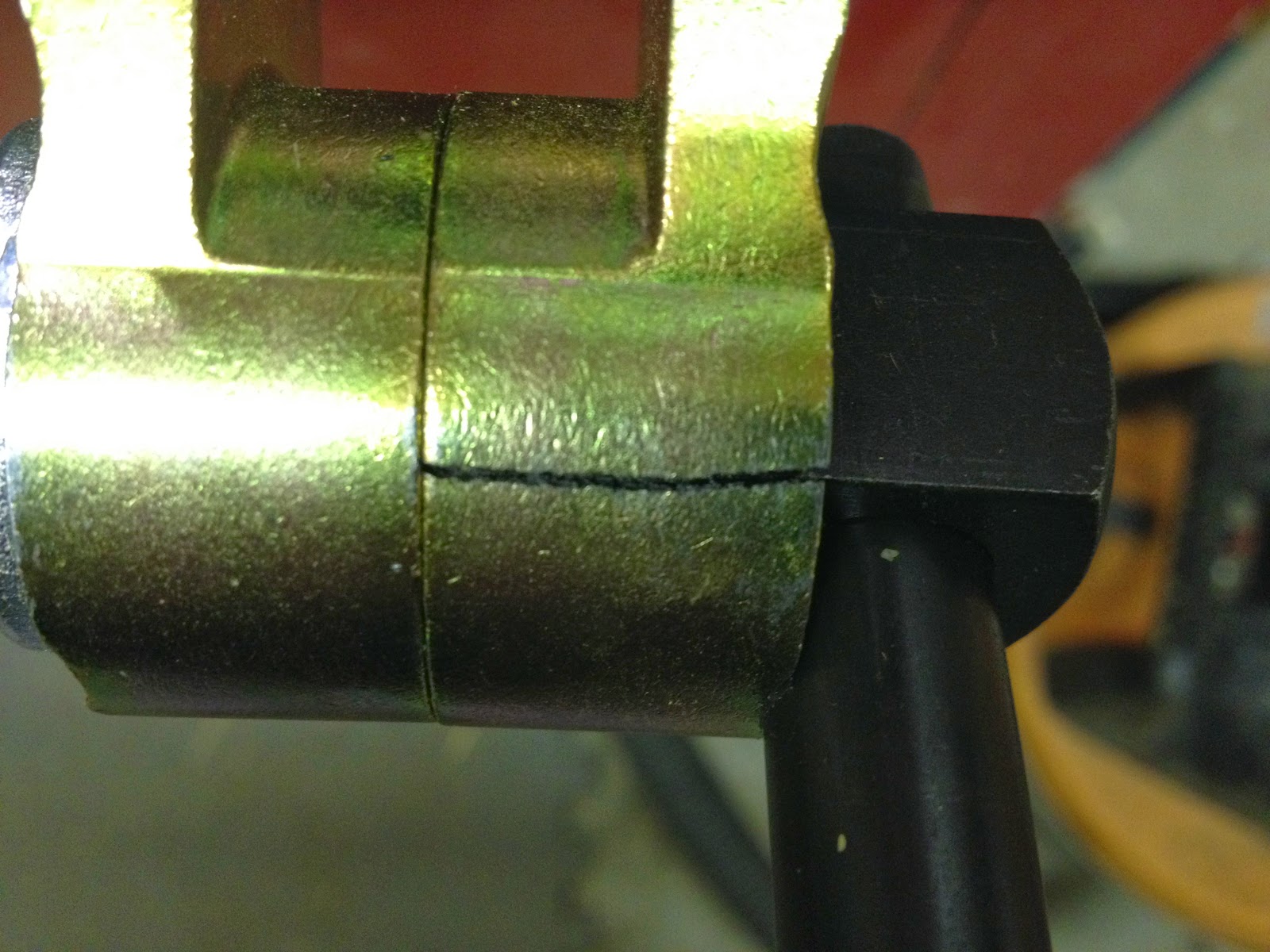
Considering their longevity, it should come as no surprise that Lee Precision does customer service well. I contacted Lee Precision through their webpage contact tool, Sunday evening I think. Sadly, I did not keep a copy of what I sent, but basically I said this is the second set of toggles to break on me and that I was not necessarily seeking free replacements but just a solution to the problem. I attached pix of both broken toggles. During the day yesterday, I received an automated email from Lee Precision thanking me for my order of “BL CHALLENGER TOGGLE” at $0.00. At first, I was a little miffed because I already had toggles on the way from MidwayUSA, but then I got another email, this one from Stephanie at Lee Precision:
Hi Robert,
I’m going to ship you a new pair of toggles in tomorrow’s mail. From your pictures, everything appears to be setup correctly with your toggle linkage. Do you mind sending back the broken toggles to the factory for inspection? I’d like to ship these back to our vendor for them to inspect.
Sincerely,Stephanie
So, very happy that they are not just willing to replace the broken parts but to try to figure out why they broke.
I replied:
Hello!
I’ll be glad to. I will enclose some documentation of the conditions and symptoms of each break. I know that I want as many details as possible when I analyze a part failure. For my opinion’s worth, this part would benefit from being thicker in the places where mine broke and if the hole through the center were square instead of eight points, it might distribute the stresses better. As it is, four long narrow bands have to withstand all the full force of my arm plus the leverage provided by the handle and in reality, only one narrow band probably gets the majority of that force. It is at the thinnest point adjacent to that contact point that the first break happens. I took the liberty of ordering another conversion handle set from MidwayUSA to ensure I had my press operational as soon as possible; I’ve been shooting for many years, but only recently discovered IDPA, so I’m shooting quite a lot these days 🙂 In any case, I will be up and running very soon. I will endeavor to keep accurate counts of rounds loaded should the situation arise again.
I’d like to take this opportunity to say that my first reloading equipment ever was a Lee O-frame press that I had back in the ’80’s. I loaded as many hundreds of 38/357 and 45 Auto as my budget would allow and I’m sure that I would not have been been able to shoot even as much as I did without the low cost and high utility of my Lee Precision equipment. So when returning after a long break from shooting, I looked at Dillon and Hornady progressives and, sweet as those presses are, the return on investment in the form of money saved reloading is measured in weeks and months with the Pro1000, as opposed to years with the others. That’s not to say I will never have one of those other presses, but the Pro1000 meets and exceeds my shooting needs today and I have no immediate plans to change.
Local IDPA match last night. Performance was similar to last week’s in that I did pretty ok on three stages and lost my brain on one. 🙂
Before I even got to the range, I had mental issues. I left home without a holster belt or concealment garment.
Since it was raining when we finished up the BUG match, I didn’t gear down at the range and my belt ended up in the closet at home with other belts. During cold weather, I have generally always had a jacket in my truck anyway, but with nice weather the last week or so, no jacket.
So…. at lunch I went to the nearby Dickies outlet store and got a 4X short sleeve work shirt. It’s just about perfect for IDPA concealment. If the tail of it was a little heavier…
As for the belt, I was lucky that the gun store at the range had a Blackhawk rigging belt big enough. I figure if I have two main pistols and two sets of holsters and mag pouches and two range bags, I guess I can justify having two belts.
Going straight to the score sheet….
I had a four procedurals, one cover call, two for tactical priority from cover and one for 16 rounds in a 15 round limited stage. Both of the tac priority calls were while re-engaging previous targets after moving to cover and I simply did them in the wrong order after moving. I think a little forethought might have helped me avoid them both. The targets in both cases could be engaged in any order in the open, but needed tac priority from cover. Perhaps planning to engage them in the same order in both conditions would have helped because apparently, that’s what I did 🙂
Stage 1 had a cover call, but otherwise, went well.
Stage 2 was just a mess. I hadn’t slammed magazine home, so I got one shot followed by a few seconds of fumbling. A couple shots in, I had a round that failed to go into battery; I racked it out so I was short to finish the six shots while retreating. I reloaded and made up that last missed shot, which set me up to miss tactical priority for the rest of those targets. I hit a non-threat on one of the remaining targets from P2. Hey, I didn’t drop the gun, so I had that going for me…
Stage 3 had a particular difficulty in that we had to shoot two of the targets from behind low cover. As soon as I knelt, my left calf cramped and I had great difficulty not toppling over forward from behind cover because I couldn’t get my uncooperative leg extended properly. Due to that gyration I had a miss on the first of those two targets.
Stage 4 was a simple stage, presented with 5 targets needing two body and one head each in any order, but it was limited to 15 rounds total. I had a miss on one of the heads and made it up out of habit. Since all the body shots had already been taken, I didn’t skip any of the head shots. Later I realized that a skipped head would have been 5 down (2.5 seconds) and the raw time might have been a second or so less. The procedural was 3 seconds, and so mathematically I may have been better off skipping the last head shot. Not that it would have made much overall difference after stage 2 🙂
So, neither my worst or best performance, but it was still fun.
I got home and while the horses were dining, I thought I would continue loading the last of my 45 Auto brass. I am down to less than 200 left to load. I’m cranking along with no particular issues when I hear that snap/clunk sound that once before heralded the eventual disconnection of the handle.
Sure enough…..
The first one broke after about 5000 rounds. This one in less than 1000, more like 800. This will not do.
Since I need to keep loading, I ordered yet another handle and toggle set today, but now I am going to contact Lee and see if there is any chance it’s something I’m doing.
The 2014 BUG “Bring-Uh-Gun” IDPA Championship Match was a big part of my weekend, duh.
However, that is not the only thing a-goin on ’round here…
A while back, I ordered some used brass from a guy I have gotten quite a bit of brass from. The brass from him has always been in really good shape and he is generous with extras to ensure his customers get the quantity they are expecting. My order of 10mm was no different. Unfortunately, he has not responded to several emails, so I suppose I need to shop elsewhere for brass now 🙁
I got a bit of a deal on this batch because he knew that it was partly small primer and partly large primer 10mm Auto and discounted it accordingly. In the last few days, I’ve been running batches of this brass through the tumbler. When I started looking at it and sorting it, I expected a relatively small percentage to be small primer. Turns out to be about half of it.
This brass also had the usual bit of mis-sorted stuff, a few 40S&W and 357 SIG, a handful of 38 Special and a couple of 223. Sadly, nothing exotic 🙂
I had gathered about box worth of rejected 45 Auto loads, mostly primer issues. I spent a bit of time pulling those rounds and reloading what I could. Mostly, they were straight forward crunched or upside down primers that just needed to be removed and redone. I don’t depend only on my safety glasses and turn my head away when I deprime cases with live primers. Afterall, they are enclosed in the resizing die when the pin hits the primer. I should probably use my universal deprimer, which does not have a tight fit over the case, but it is also really easy to not have the case aligned properly and break the pin. It’s on it’s third pin now. Plus, there is no safe way, for the weapon or user, to fire them in a gun, so I just grit my teeth and do it with the press. I have never ever had a primer go off in the press, so it must be ok 🙂
Anyway, I had a few of these 45’s for which the original primer just didn’t seat all the way in. Even with a second attempt, they began to distort without seating any deeper. I retried a couple of them and they still wouldn’t seat, so I just tossed them in the trash. It finally occurred to me to check one them closely and this is what it looked like.
The original primer cup had split when it was pressed out and only part of the primer came free. There was a ring left in the pocket blocking the new primer from fully seating.
13 stages, plus a steel sidematch, all with Back Up Gun loaded to 5 rounds and several with nifty pick-up guns. Overall, I shot my Kahr CW40 fairly well, finishing at the center of my division.
The sky flirted with raining on us, but it did not really come down until after all shooters had finished. Stages were shot in semi-random order based on bay availability. My squad started in the middle, stage 12 if I recall correctly.
There was a suppressed Walther P22 for the pickup gun. You begin handcuffed and seated with the P22 on the table in front of you. Your BUG is in a box across the room. At the buzzer, you pick up the Walther, place two rounds in each of three targets, either seated or on the move then retrieve your BUG and place one round in each of 4 remaining targets from three covered positions, two with non-threats adjacent.
What a way to start a match!
Here is Paul V’s run at this stage:
For this stage, I had 1 down each on 4 of the targets and 1 hit on a non-threat.
I wont belabor the details on the score numbers, but basically it went like this:
While I did have several FTNs and a hit on non-threat, I only had one procedural for cover and I’m pretty happy with that. I like all those “0 errors” in that list.
Since I did not record the order in which we shot the stages, I will just highlight a few.
Stage 1 started in an unusual manner. For the scenario, your spouse has been taken hostage by thugs, one of them has a knife to her throat. After drawing your weapon they refuse to let her go. You are convinced they will kill you both as the others start toward you. For the start, the shooter has the target in the sights and finger on the trigger and calls “Drop the knife!” to indicate ready. At the buzzer, place one shot on each of 5 targets. I got them all. My only zero down stage!
Stage 2 had a Beretta 92 pickup gun. In the scenario, you are cleaning the pistol when thugs invade your home. Your BUG is in a keylocked safe across the room, but there is a partial magazine for the Beretta on the table. At the buzzer, you load the Beretta, place two rounds in each of two targets, then retrieve your BUG to take out the remaining 4 targets from cover at two positions.
Stage 4 had a Ruger pickup gun. In the scenario, you have been taken hostage by home invaders. Your BUG is in the drawer next to you. Your spouse stomps on the invader’s foot, making him drop his gun on the table in front of you. You see your chance and take it! At the buzzer, you pick up the Ruger and place two shots on each of the two nearest targets, retrieve your BUG from the drawer and place two in each of two remaining targets.
Stage 6 had a cool prop, named the Boone Flipper in honor of the CTASA member who designed it. In the scenario, you see two thugs and their pit bull attacking a woman. You shoot each once, but the two thugs get back to their feet and need two more shots! This is accomplished with a pair of hinged target stands and a steel popper target. When you shoot the popper, it falls forward, catching two arms on the target stands. It’s weight pulls those targets down while lifting the other two into position. This one is way easier to understand on this video featuring Matt C, who would go on to place first in Expert division.
Most shooters placed one shot on each target, then shot the steel. Matt’s plan definitely saved him some time. He shot one paper target, then the steel. While waiting for the steel to fall, he shot the other paper target. Then, of course, the two new targets once presented. My time on this stage was 6.18 but Matt’s was only a tiny bit more than half of that. That would be why he is Expert 🙂
Stage 7 was probably the coolest pickup gun ever, an AR pistol.
There are 7 targets, but you are required to place 1 shot through each of 7 ports. Once your BUG runs dry, you pick up the AR pistol for the last two. Here is Todd H running though it:
The time to be gained was in selection of the port order to conserve movement. A shooter gave me what I think was a good tip on order of shots. I was first first going to just go left to right, but he suggested a specific order that seemed to work well. Note that each port has a color. He suggested black, red, blue, white and gray. By going in that order, I was able to get the first three with minimal foot movement, then crab right and stand up for the last two. Then move to the AR for those two. I didn’t notice at first, that the left barrel was pointed more towards the right target and vice versa. This might have made it slightly easier to line up those two targets. For the first one, I shot very low, a 5 that was actually on the paper. See the paster at the very bottom. 🙂
The real joy of the stage, however, was the report of the short barreled AR, particularly fired within the tube. It was a very satisfying thump, with a big muzzle flash and the occasionally moved hat bill or lock of hair. It’s a shame that we only got two rounds out of it.
Stage 9 involved shooting kind of from retention from under a counter. Your working the night shift at the local convenience store when 5 armed thugs come to rob and eliminate all witnesses. The first three come to the counter, then the getaway driver and the rest of the gang come in with a hostage. To set up, your BUG is in hand under the counter in a specific spot and a big revolver loaded with 3 rounds is in the cash box. At the buzzer, you engage each of three targets with one shot each from under the counter, then engage again from above the counter with one shot to two of the three heads. Retrieve the revolver and engaging two steel targets. If you’re good, you have one round left in the revolver for any makeup shots. I managed two down 5’s and one down one, but avoided the dreaded FTN. The revolver was originally a S&W Governor, but it developed issues and was substituted with an equally substantial S&W 625 with the same 45 Auto ammo. It was a very nicely tuned revolver and shot quite nicely.
Stage 10 was bizarre. For the scenario, you are taken by terrorists, they have put a hood over your head and are rounding up the rest of the family. As one of them attempts to tie your hands you grab his gun and save your family. For the start, you have the opportunity to get set with your aim at T1, then the SO places a hood over your head. At the buzzer, you fire at least one shot before removing the hood and engaging the rest of the targets.
Here’s Paul again:
Stage 11 was the last one our squad shot and it was the one I would have least expected to do well on. For the scenario, a crazy man with a knife is attacking and he won’t hold still, he must be jacked up on drugs as your first shots have no effect. Your BUG is on the table. You activate a swinger with your strong hand then engage the swinger with a Mozambique, but there is a non-threat directly in front of you. Just to ensure you don’t have any spare ammo left, you must also take a steel gong behind another non-threat.
Here is William M running through this one:
I was very pleasantly surprised to have only 1 down on the swinger. It cost me time, but I left my pistol relatively stationary at the left hand apex of the swing and took my shots there. After three, I took careful aim at the steel so I would have one more for the swinger and took that one at the head. The strategy worked.
Stage 13 was the first time I had engaged a mover. The mover is a target stand that on rails with a spring loaded cable to pull it one direction or another, in this case straight towards you. At the end of it’s travel, the target falls over forward and is no longer available. I did not capture video of this one, but Matt C had his GoPro camera running on his go at it. The thing moves pretty quick!
There was also a chronograph set up. A chrono stage was required for the Big BUG contenders because ammo was required to make 165 power factor in a 5 inch barrel to qualify as Big. However, for information gathering purposes, all guns were chronographed and the information logged. In my squad, a lot of the guys load pretty light for recoil reasons, which is fine. What I was shooting happened to have been loaded before I had any IDPA experience, so I just made them medium hot. Out of the short barrel of the Kahr, it makes pretty good boom (especially in Stage 9’s shooting-inside-a-box scenario) and three shots chrono’d at 1000-1050 FPS. It was first assumed to be factory ammo, probably between the heat and that they are really shiny copper plated bullets in nickel plated cases.
Raffle tickets for a Kahr PM9 (didn’t win it) served as entries for the steel sidematch. I bough a few tickets, but I only took one run at the steel because we approached that stage in the middle of the match and I didn’t want to spend too much time on it and delay the squad. After all the stages were shot and we were waiting on the scores to be tallied, several people rejoined the steel match and I probably should have just for the fun of it. Then again, that’s when the rain actually came down. It’s fun to have about 50-60 people crammed under a 20×20 shed roof.
My total score was 211.69, ranking me 7th of 13 completed scores for Standard BUG – Marksman. That got me no trophies, but I was very happy to not be near the bottom of everything as I frequently have been. I am getting a grasp of it. While I won no trophies, I did win a random drawing for a $25 Cabelas gift card. Heck, that’s about half what the match registration cost. That’s nearly free as far as I’m concerned. Well, if you don’t count ammo… or gas… or breakfast and lunch… and the magazines and holster I got to make life easier….
A bit of trivia. So far as I could tell by overheard conversations, the longest distance traveled seems to have been a lady who came from Seattle to play. She commented that, yes, it rains all the time in Seattle, but it doesn’t pour like it was at the time she mentioned it. They generally just keep shooting in the misty drizzle that they mostly get.
A good time was had by all and about 4PM, I headed for home, tired, a little sore, a little damp and surprisingly, a little sunburned. Rain was pretty hard for most of the drive home, so it was a little slow going.